
Grogneur métis (Bastard grunt)
Pomadasys incisus (Bowdich, 1825)
Family Haemulidae • the small silvery grunt of coastal grounds
2 look-alikes to know
| French name | Grogneur métis. Other names: carpe-blanche, grogneur bâtard, bâtard. |
|---|---|
| Scientific name | Pomadasys incisus (Bowdich, 1825) |
| Family | Family Haemulidae |
| English name (FAO) | Grogneur métis (Bastard grunt) |
| Local names | On Ivorian markets and landing sites: “Carpe blanche” (Ouattara et al., 2016). |
| Habitat | Marine, coastal demersal over soft sandy and muddy bottoms of the shelf. |
| IUCN status | LC Least Concern. A common species of coastal grounds. |
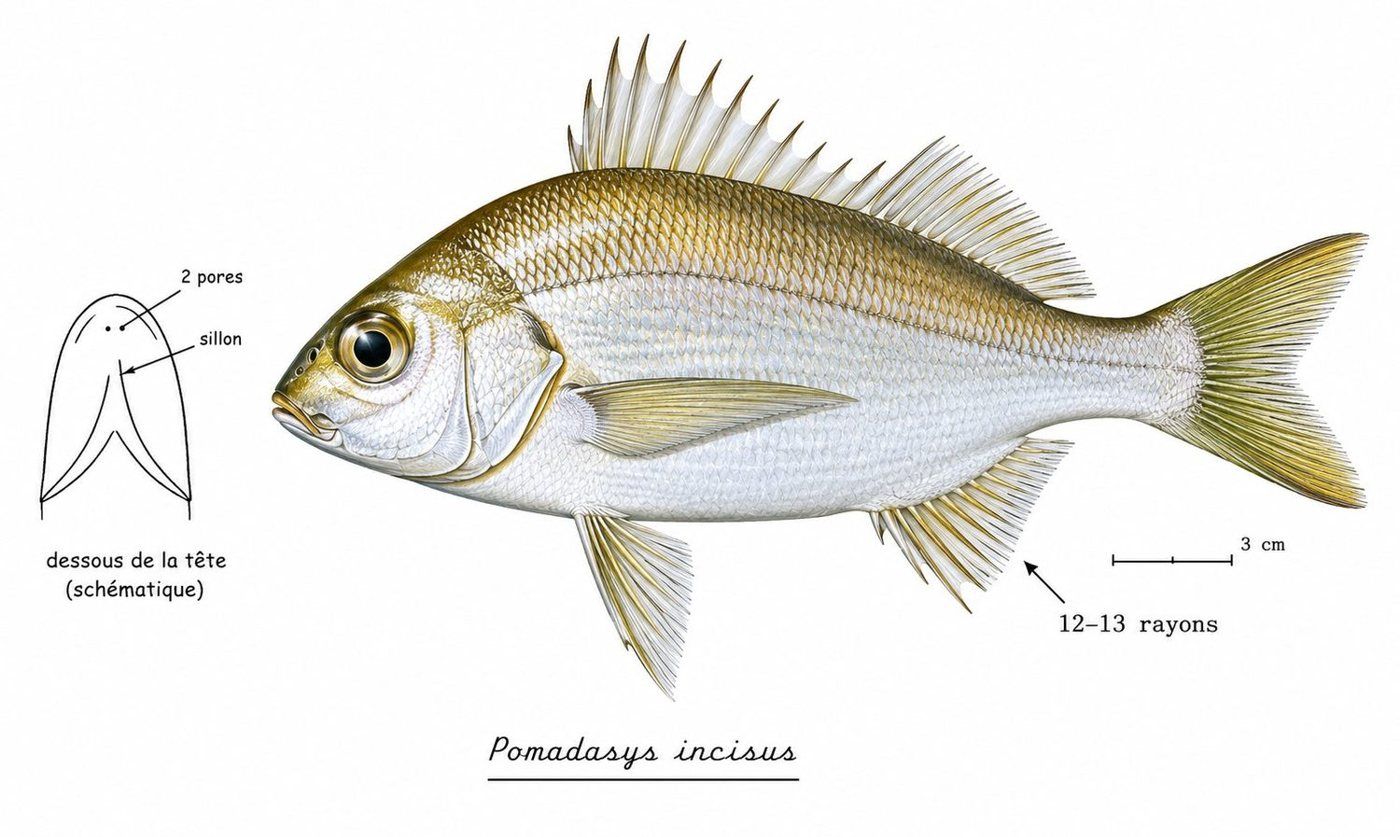
Plate: Guide de détermination des poissons des lagunes de Côte d'Ivoire (identification guide to the fishes of the lagoons of Côte d'Ivoire), E. Charles-Dominique and J. Raffray, CRO Abidjan, Archives scientifiques, 1986. Working reproduction, rights to be confirmed before publication.
Identification
A small grunt with an oval, compressed body, silvery with reflections, back slightly darker. Two pores and a pit under the chin, like all Pomadasys. Often a yellow tinge on the upper back or at the base of the dorsal fin. Produces grunting sounds. Smaller than its relatives.
Features that never mislead
Small size for a grunt, oval compressed body.
Two pores and a chin pit, the mark of the grunts.
Frequent yellow tinge on the upper back.
Produces grunting sounds with the swim bladder.
Size and weight
A small grunt, typical catches around 15 to 25 cm. Maximum size about thirty centimetres depending on the population. To be confirmed on FishBase for the Ivorian coast.
Behaviour and ecology
A coastal, gregarious demersal species that searches soft bottoms for worms, molluscs and small crustaceans. Forms concentrations on the shelf.
Present in the Eastern Atlantic, from West African waters to the Mediterranean, where it is spreading. Common on the Ivorian coast in bottom fishing. IUCN status: Least Concern.
Reproduction and season
Coastal spawning, pelagic eggs and larvae. Early maturity. Local spawning data to be documented.
Fishing practice
Techniques, from most to least effective
Bottom fishing with small bait (worm, shrimp) over coastal grounds.
With a baited multi-hook rig (sabiki type) over concentrations.
Caught in coastal trawls and nets.
The fight: modest given the small size, vibrations on fine line. Mainly a frying and market fish, caught in numbers.
Eating quality
Decent white flesh, eaten fried or braised, often sold in batches. A popular fish at an affordable price. To be eaten fresh.
Sources: FishBase (Pomadasys incisus, Bowdich 1825); IUCN Red List, LC; FAO Eastern Central Atlantic; Ouattara et al. 2016.