From the surface to the seabed: where each fish lives
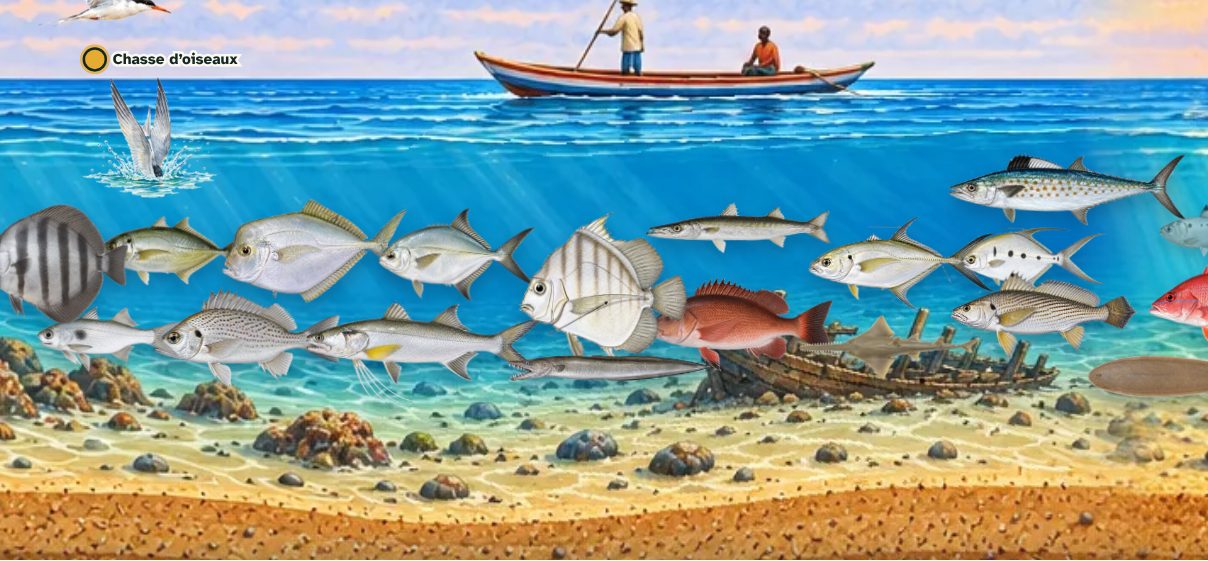
A fish does not live “in the sea” in general: it lives at a precise level, from the surface down into the sand of the seabed. Knowing at which level the species you are after lives already tells you where to put your bait or swim your lure.
 Dive from river to open ocean →
The five levels, from the surface to the seabed
1Surface
epipelagic · 7 species
The first few metres below the surface. Fast swimmers hunting baitfish in the sunlight: boiling feeding frenzies, diving birds, fish gathered under floating objects.
How to fish them: Trolling, surface lures, casting at feeding frenzies.
2Open water
pelagic · 26 species
The whole water column, away from the bottom. Streamlined fish, often in schools, that follow baitfish and water fronts without depending on the seabed. Offshore as well as over the shelf.
How to fish them: Trolling, jigging, live bait or drifting dead bait.
- Yellowfin tuna
- Bigeye tuna
- Skipjack tuna
- Atlantic chub mackerel
- West African Spanish mackerel
- Swordfish
- Atlantic blue marlin
- Crevalle jack
- Blue runner
- Senegal jack
- Atlantic bumper
- Pompano
- Guinean barracuda
- Guachanche barracuda
- Mafou (Cobia)
- Smooth puffer
- Fiatole (Blue butterfish)
- Bonga shad
- Sardinelle ronde (Round sardinella)
- Sardinelle plate (Madeiran sardinella)
- Comète maquereau (False scad)
- Requin bleu (Blue shark)
- Requin-marteau halicorne (Scalloped hammerhead)
- African bonytongue
- Tigerfish
- Large-scale silverside (group Brycinus)
3Near the bottom
benthopelagic · 21 species
They swim freely but stay tied to the bottom: schools above rocks, wrecks and sand, which go down to feed and rise back into the water column.
How to fish them: Handline fished just off the bottom, slow jigging, fishing on a held line.
- African moonfish
- Cunene horse mackerel
- Shortfin pompano ◦
- Longfin pompano ◦
- Largehead hairtail
- Denté à bosse (Pink dentex)
- Pagre à points bleus (Bluespotted seabream)
- Bogue
- Croupia roche (Tripletail)
- Blackchin tilapia ◦
- Flathead grey mullet
- Mulet curème (Sicklefin mullet) ◦
- Disque africain (African sicklefish)
- Spadefish de Gorée (West African spadefish)
- Sole-lune africaine (African moony) ◦
- Aba aba, African knifefish
- Nile perch
- Nile tilapia
- Redbelly tilapia ◦
- Banded jewelfish ◦
- Grass eater (group Distichodus)
4On the bottom
demersal · 40 species
They live in contact with the bottom, feed and shelter there: rocks, wrecks, sand, mud. The relief tells you where to find them, from inshore grounds down to the slope.
How to fish them: Handline, bottom fishing, surfcasting near structures.
- Merlu
- White grouper
- Mérou de Gorée (African hind)
- Canary dentex
- Denté de l'Angola (Angolan dentex)
- Pageot à têche rouge (Red pandora)
- West African goatfish
- Vivaneau à dents de chien (African brown snapper)
- Vivaneau guinéen (African red snapper)
- Vivaneau doré (Golden African snapper)
- Vivaneau de Gorée (Gorean snapper)
- Grogneur sompat (Sompat grunt)
- Grogneur de Roger (Pigsnout grunt)
- Grogneur métis (Bastard grunt)
- Diagramme gris (Rubberlip grunt)
- Baliste cabri (Grey triggerfish)
- Baliste à taches (Bluespotted triggerfish)
- Saint-Pierre (John Dory)
- Tile à bandes (Zigzag tilefish)
- Brotule barbée (Bearded brotula)
- Hoplostète (Mediterranean slimehead)
- Bagrid catfish
- Mâchoiron à grandes plaques (Rough-head sea catfish)
- Grand capitaine (Giant African threadfin)
- Petit capitaine (Lesser African threadfin)
- Cassava croaker
- Otolithe nanka (Longneck croaker)
- Murène-brochet féroce (Guinean pike conger)
- Émissole lisse (Common smooth-hound)
- West African lungfish
- Elephant-snout fish
- Electric catfish
- African sharptooth catfish
- Sampa, vundu catfish
- Upside-down catfish (group)
- Bayad
- Giraffe catfish
- Senegal bichir
- African snakehead
- African carp (group Labeo)
5In the bottom
benthic · 12 species
Lying on the bottom or buried in sand and mud, often flat or camouflaged: soles, turbot, rays, torpedo, scorpionfish, lizardfish. Rarely seen, they are caught on the bottom.
How to fish them: Bottom fishing with natural bait, surfcasting. Beware of spines and stings.
- Red scorpionfish
- Rascasse de Kuhl (Offshore rockfish)
- Grondin volant (Flying gurnard)
- Anoli de mer (Snakefish)
- Turbot épineux (Spottail spiny turbot)
- Sole-langue de Monod (Guinean tonguesole)
- Petite sole (Frechkop's sole)
- Daisy stingray
- Spiny butterfly ray
- Common guitarfish
- Common torpedo (ocellate torpedo)
- Largetooth sawfish
Four habitats, from river to open ocean
Rivers, streams, reservoirs, ponds and floodplains. Mostly shallow: you find schooling open-water fish and many bottom species, catfishes first among them.
A shallow, brackish inland sea behind the coastal barrier, linked to the ocean by the passes. Mullets, tilapias, catfishes, and the sea fish that come in with the tide.
From the beach to the edge of the continental shelf. This is where the five zones are easiest to read: surface schools, jacks in open water, dentex above the rocks, groupers on the bottom, soles and rays in it.
Beyond the slope, the bottom is out of reach: everything happens at the surface and in open water, tunas, dolphinfish, sailfish, marlins. Only a few deep-sea species are fished on the slope.
Classification based on the “Habitat” section of each species sheet. A species may change level with age, season or time of day (many rise at night): the level given is where it is most often found. ◦: classification to be confirmed.