
Croupia roche (Tripletail)
Lobotes surinamensis (Bloch, 1790)
Family Lobotidae • the three-tailed fish of floating objects
1 look-alike to know
| French name | Croupia roche. Other names: carpe de mer, poisson-feuille, triple-queue. |
|---|---|
| Scientific name | Lobotes surinamensis (Bloch, 1790) |
| Family | Family Lobotidae |
| English name (FAO) | Croupia roche (Tripletail) |
| Local names | On Ivorian markets and landing sites: “Carpe de mer” (Ouattara et al., 2016). |
| Habitat | Marine and brackish, benthopelagic. Depth 0 to 70 m. Near floating objects, wrecks and structures. |
| IUCN status | LC Least Concern. A widely distributed species, fished locally. |
Identification
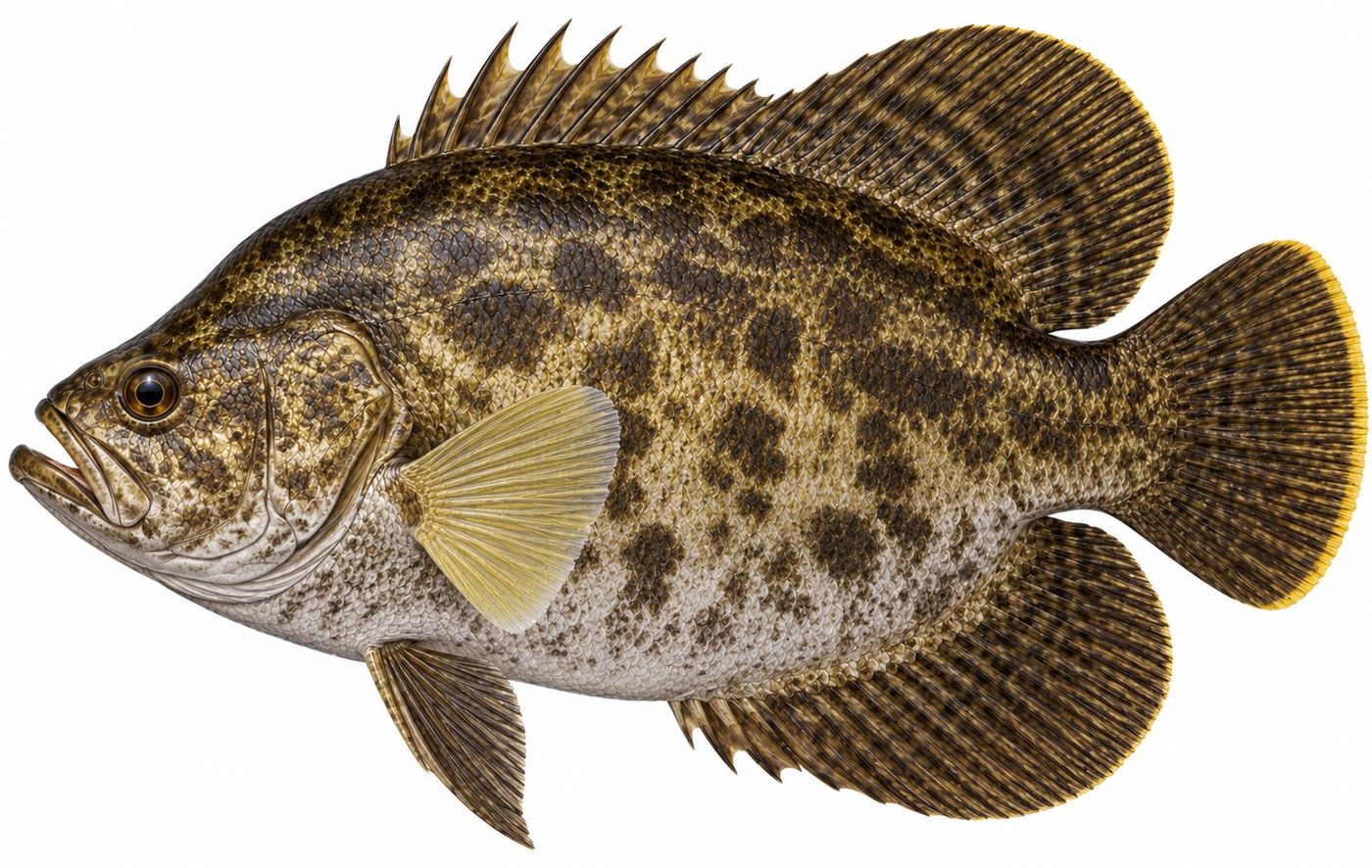
A robust fish with a deep, compressed body, dark brown to greenish yellow above, silvery grey below. Concave forehead, small eyes near the snout, large oblique mouth with thick lips. A unique feature: the rounded dorsal, anal and tail fins, of similar size, give the illusion of three tails, hence the name tripletail.
Features that never mislead
Rounded dorsal, anal and tail fins of similar size, looking like three tails.
Concave forehead, small eyes near the snout.
Dark brown to greenish yellow livery above, silvery below.
Large oblique mouth with thick lips.
Size and weight
Common size around 80 cm. Published maximum length 110 cm total length, for a maximum weight of around 19 kg (FishBase). It is a fine game fish.
Behaviour and ecology
A solitary species that stays near floating objects, wrecks, buoys and structures, often lying on its side at the surface to watch for prey. A predator of fish and crustaceans. Juveniles drift with floating seaweed.
Present in the tropical and subtropical waters of all oceans. In the Eastern Atlantic, presumed from Gibraltar to the Gulf of Guinea. Caught on the Ivorian coast near structures. IUCN status: Least Concern.
Reproduction and season
Spawns offshore or near the coast in the warm season. Females mature at one or two years. Larvae go through several stages before reaching floating objects.
Fishing practice
Techniques, from most to least effective
Casting lures or bait near floating objects, wrecks and buoys. The top technique, sight fishing.
Drifting a live bait near a located structure.
Bottom fishing near coastal reliefs.
The fight: powerful and cunning, the tripletail dives under its structure to saw through the line. On the bite, you must immediately draw it away from the wreck or buoy where it was holding.
Eating quality
White, firm and excellent flesh, among the finest of coastal fish. Much appreciated baked or grilled. Sought after by connoisseurs.
Sources: FishBase (Lobotes surinamensis, Bloch 1790); IUCN Red List 2015 (LC); FAO Eastern Central Atlantic; Ouattara et al. 2016.