
Hoplostète (Mediterranean slimehead)
Hoplostethus mediterraneus Cuvier, 1829
Family Trachichthyidae • the armoured fish of great depths
3 look-alikes to know
| French name | Hoplostète. Other names: hoplostète méditerranéen, poisson-montre. |
|---|---|
| Scientific name | Hoplostethus mediterraneus Cuvier, 1829 |
| Family | Family Trachichthyidae |
| English name (FAO) | Hoplostète (Mediterranean slimehead) |
| Local names | On Ivorian markets and landing sites: “Rascasse” (Ouattara et al., 2016). |
| Habitat | Marine, demersal in the great depths of the continental slope, often beyond several hundred metres. |
| IUCN status | LC Least Concern. Precise status to be confirmed. |
Identification
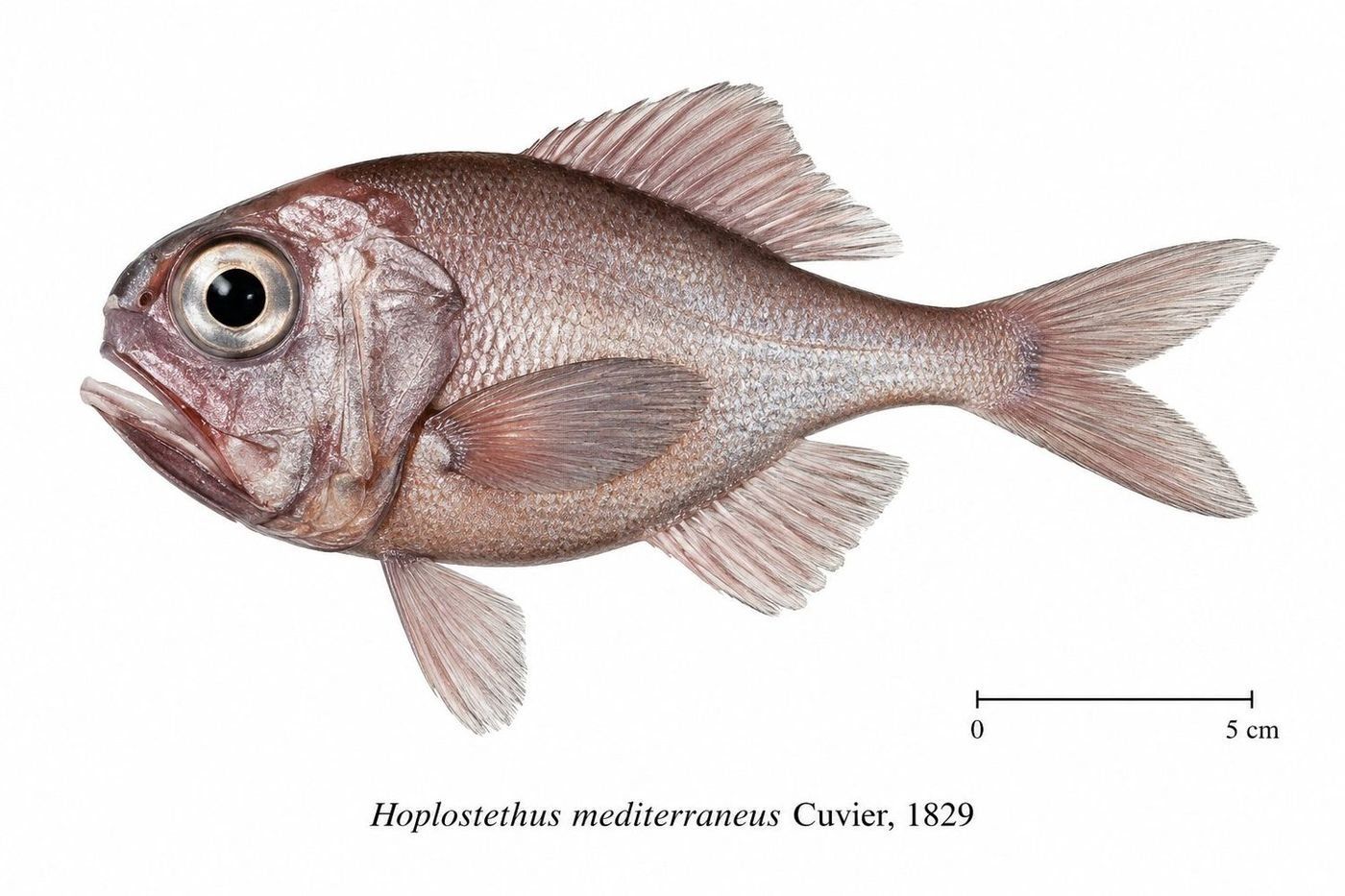
A small deep-water fish with a deep, compressed body, bright pink to reddish, a large head hollowed with mucous cavities and armed with bony ridges. Large eyes adapted to darkness. Hard scales, belly with spiny scutes. It is a close cousin of the orange roughy fished in deep waters elsewhere in the world.
Features that never mislead
Deep, compressed body, bright pink to reddish.
Head with mucous cavities and bony ridges, large eyes.
Belly with spiny scutes, hard scales.
A species of the great depths of the slope.
Size and weight
A small deep-water fish, typical catches in the order of twenty centimetres. Precise maximum size to be confirmed on FishBase.
Behaviour and ecology
A species of the great depths living near the slope substrate, feeding on small crustaceans and deep-water planktonic organisms. Very slow growth and long lifespan, typical of abyssal fish.
Present on the West African slope and in the Mediterranean. Caught in deep-water fishing off Côte d'Ivoire. IUCN status: Least Concern.
Reproduction and season
Spawns at great depth; spawning data poorly known. Slow growth. To be documented.
Fishing practice
Techniques, from most to least effective
Caught in deep slope trawls.
On deep longlines, incidentally.
Rarely targeted specifically with a line.
The fight: practically non-existent, given the depth and the small size. It is mainly a catch of deep trawls and a witness to slope ecosystems.
Eating quality
Decent flesh; slimeheads are exploited elsewhere in the world, but caution is advised, as these abyssal fish accumulate age and sometimes contaminants. Limited local consumption.
Sources: FishBase (Hoplostethus mediterraneus, Cuvier 1829); FAO Eastern Central Atlantic; Ouattara et al. 2016; IUCN status to be reconfirmed.