
Turbot épineux (Spottail spiny turbot)
Psettodes belcheri Bennett, 1831
Family Psettodidae • the primitive flatfish that swims to hunt
1 look-alike to know
| French name | Turbot épineux. Other names: sole collant, turbot de Guinée, faux turbot. |
|---|---|
| Scientific name | Psettodes belcheri Bennett, 1831 |
| Family | Family Psettodidae |
| English name (FAO) | Turbot épineux (Spottail spiny turbot) |
| Local names | On Ivorian markets and landing sites: “Sole collant” (Ouattara et al., 2016). |
| Habitat | Marine and brackish, demersal over coastal soft bottoms. Depth down to 150 m. |
| IUCN status | NE Not Evaluated / to be checked. A commercial flatfish under fishing pressure. |
Identification
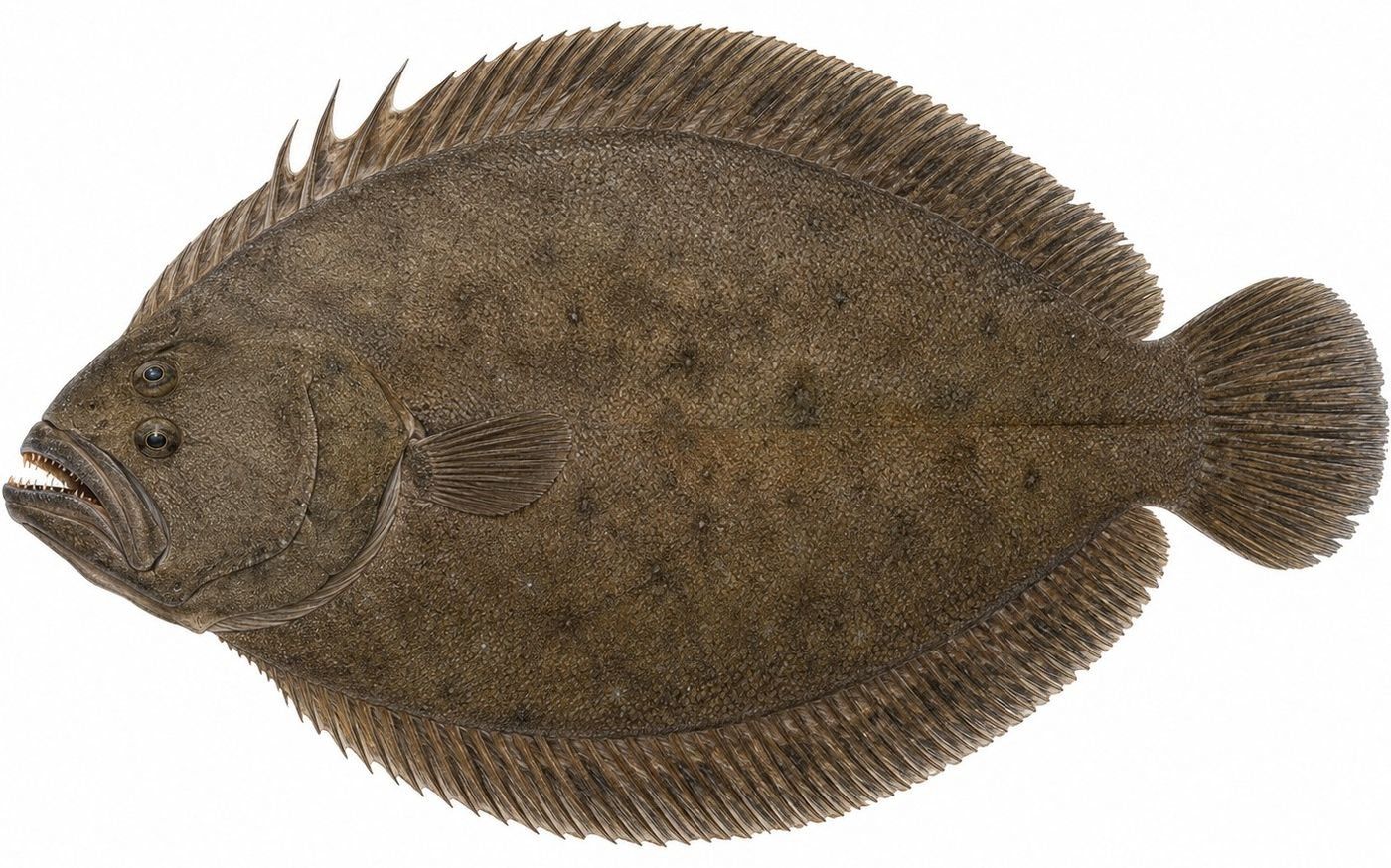
A large, primitive flatfish, less asymmetrical than true turbots and soles. Broad body, almost as wide as it is long, brown to olive on the eyed side. A distinctive feature: it bears spines on the dorsal and anal fins, a legacy of its perciform ancestors. Large mouth armed with strong teeth. The position of the eyes varies, sometimes on the right, sometimes on the left.
Features that never mislead
Spines on the dorsal and anal fins, rare in flatfishes.
Broad body, almost as wide as it is long, only slightly asymmetrical.
Large mouth with strong predator’s teeth.
Eyes sometimes on the right, sometimes on the left depending on the individual.
Size and weight
Common size around 45 cm. Published maximum length 80 cm total length, for a maximum weight of about 15 kg (FishBase). It is a large flatfish.
Behaviour and ecology
Unlike other flatfishes, the spottail spiny turbot does not always stay flat on the bottom: it is an active predator that readily swims up into the water column to chase its prey, fish and crustaceans.
Present in the eastern Atlantic from Mauritania to about 14 degrees south. Caught over Ivorian coastal soft bottoms. IUCN status to be checked.
Reproduction and season
Coastal spawning, pelagic eggs and larvae. The young go through the flatfish metamorphosis, with one eye migrating to the other side. Local spawning data to be documented.
Fishing practice
Techniques, from most to least effective
By bottom fishing with natural bait (fish, shrimp) over soft bottoms.
By surfcasting from the beaches, over sand.
Caught in coastal trawls and nets.
The fight: livelier than that of ordinary soles, this flatfish struggles and swims. Strong for a flatfish. When bringing it aboard, beware of the fin spines.
Eating quality
White, firm and fine flesh, highly prized like that of the best flatfishes. Excellent grilled or as fillets. Good value on the markets.
Sources: FishBase (Psettodes belcheri, Bennett 1831); FAO Eastern Central Atlantic; Ouattara et al. 2016; IUCN status to be reconfirmed.