
Sardinelle ronde (Round sardinella)
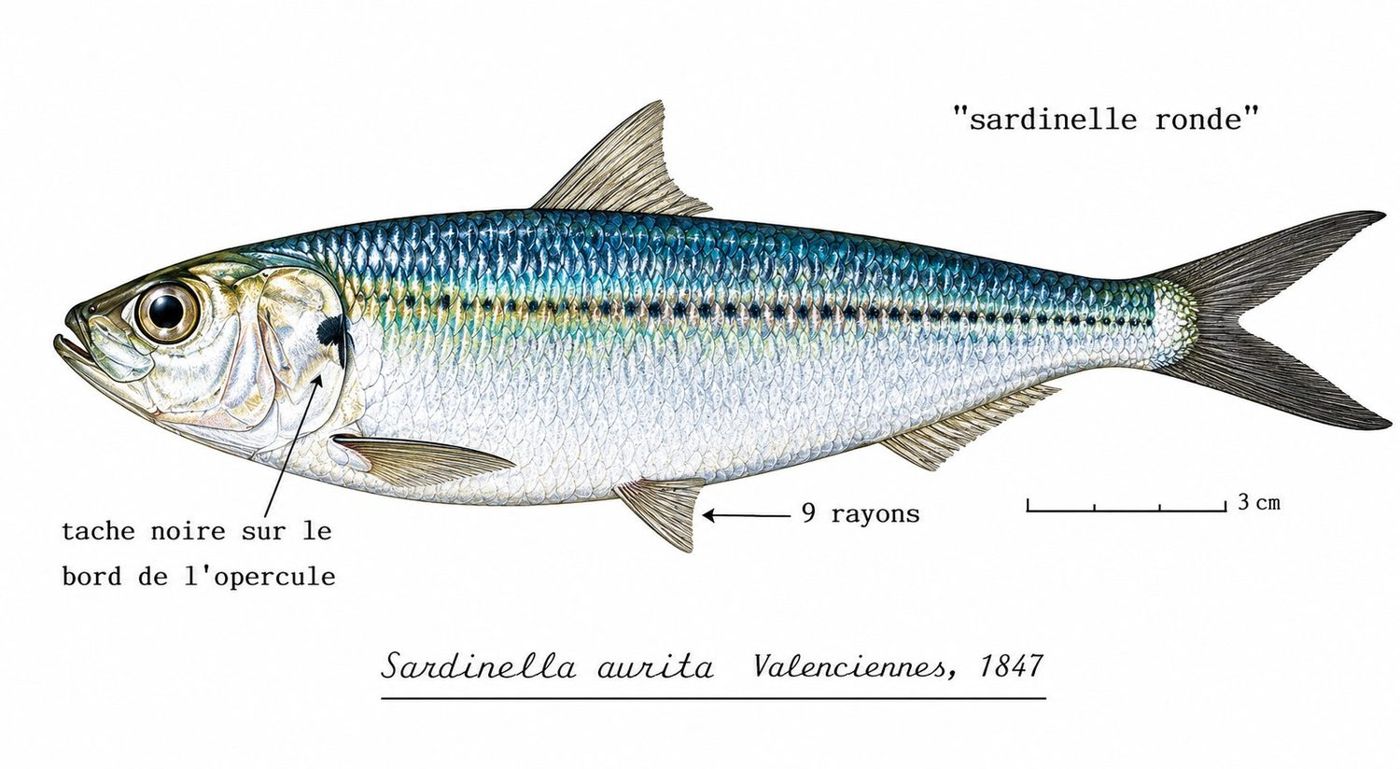
Sardinella aurita Valenciennes, 1847
Family Clupeidae • the large sardinella of coastal schools
3 look-alikes to know
| French name | Sardinelle ronde. Other names: mangne sardine, allache, sardine espagnole. |
|---|---|
| Scientific name | Sardinella aurita Valenciennes, 1847 |
| Family | Family Clupeidae |
| English name (FAO) | Sardinelle ronde (Round sardinella) |
| Local names | On Ivorian markets and landing sites: “Mangne sardine” (Ouattara et al., 2016). |
| Habitat | Marine, coastal pelagic. Warm waters, forms large schools over the shelf, tolerates estuaries. |
| IUCN status | Least Concern (LC), IUCN Red List, assessed on 23/08/2012; old assessment, regional stock under heavy pressure. Major small pelagic, under heavy fishing pressure. |
How to recognise it
- elongate, almost cylindrical body, rounded belly with a keel of scutes;
- distinct black spot on the rear edge of the gill cover;
- faint golden line along the middle of the flank, preceded by a faint golden spot behind the gill opening;
- pelvic fin with 9 rays (1 + 8); more than 80 fine gill rakers on the lower part of the first arch.
Do not confuse with: the Madeiran sardinella (Sardinella maderensis), deeper body, pelvic fin with 8 rays; the bonga shad, deep body, yellow caudal fin, notched jaw.
Size
Common size 25 cm (standard length); maximum 41 cm (FishBase).
Life, fishing and table
Behaviour and ecology
A gregarious pelagic species that forms huge schools in the warm, productive waters of the shelf, filtering plankton with its gill rakers. Highly mobile, sensitive to temperature and upwelling.
Present on both sides of the Atlantic and in the Mediterranean. A mainstay of West African coastal fisheries and of Ivorian food security. IUCN status: Least Concern, but the stock is under strain.
Reproduction and season
The gonads develop in April, with maturity one month later. Spawning from late June to September, with abundant pelagic eggs and larvae in the spawning areas. High fecundity.
Fishing practice
Techniques, from most to least effective
With purse seines and nets, the dominant commercial method on the schools.
With a multi-hook rig of small hooks (sabiki) on the school.
Caught in coastal nets.
The fight: modest given its size, vibrations on a fine line. It is above all a seine and market fish, and an excellent live bait for large pelagics.
Eating quality
Rich, tasty flesh, a staple of everyday diets. Excellent grilled, charcoal-grilled (braisé) or smoked, very common and cheap on all Ivorian markets. Best eaten fresh.
Status
Least Concern (LC), IUCN Red List, assessed on 23/08/2012 (via FishBase, checked on 25/10/2026); old assessment, regional stock under heavy pressure.
Local names
« Mangne sardine »: markets and landing sites of Côte d'Ivoire (Ouattara et al., 2016); language to be specified.
Sources: FishBase, Sardinella aurita (accessed on 25/10/2026); V13 species sheet 66.