
Spiny butterfly ray
Gymnura altavela (Linnaeus, 1758)
Family Gymnuridae • the ray wider than it is long, a glider over the sand
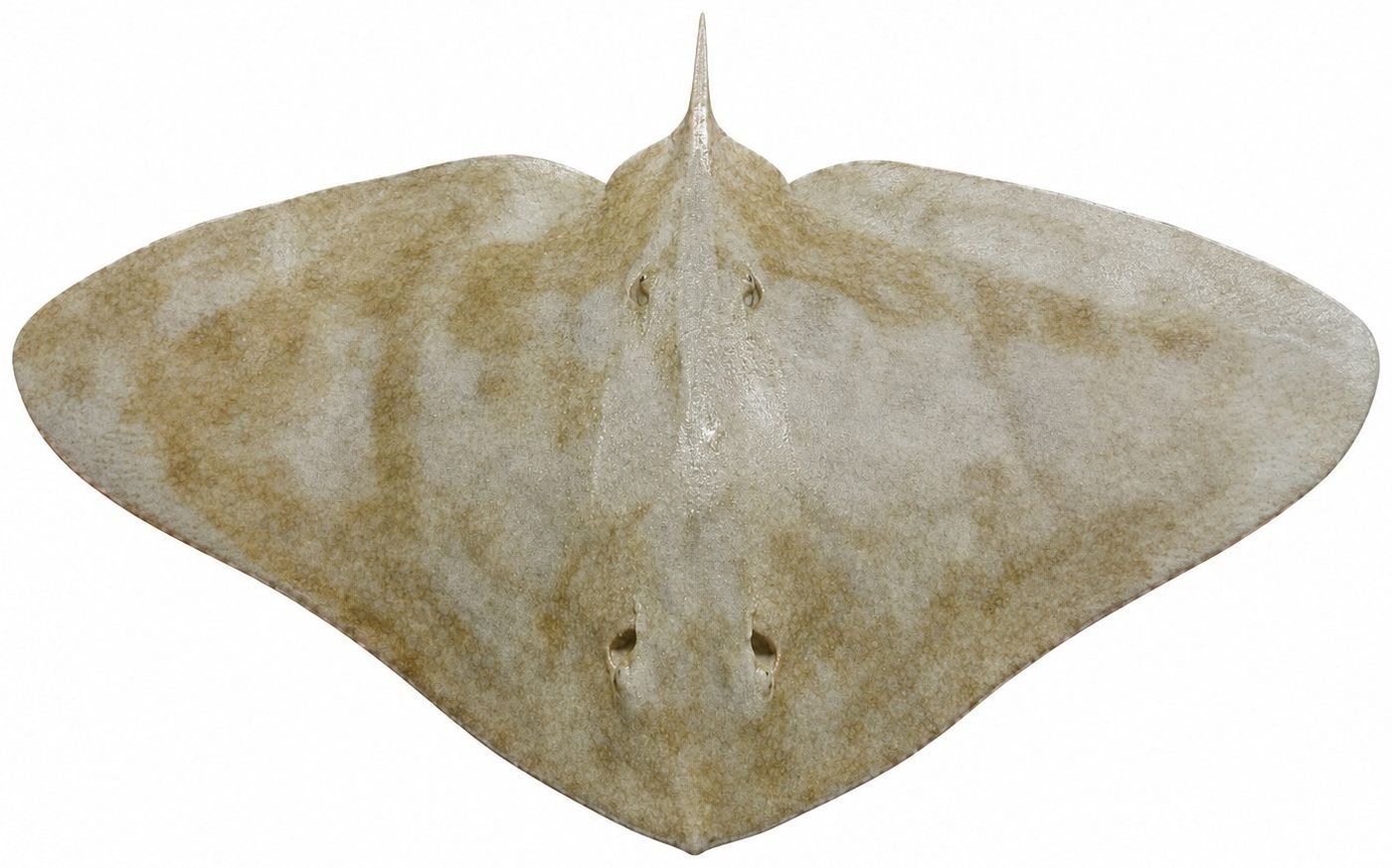
| French name | Raie-papillon épineuse |
|---|---|
| Scientific name | Gymnura altavela (Linnaeus, 1758) |
| Family | Family Gymnuridae |
| English name (FAO) | Spiny butterfly ray |
| Local names | Raie-papillon; local names to be documented |
| Habitat | Coastal marine, sandy and muddy bottoms, shallow depths; demersal. |
| IUCN status | EN Endangered. Heavily affected by coastal fishing. |
Identification
A ray with a very wide, short disc, clearly wider than it is long (butterfly-wing outline), mottled grey-brown above, blending with the sand, pale below. Very short, thin tail, sometimes bearing a small sting. Short snout.
Features that never mislead
Disc much wider than long (“butterfly” look), the signature of the group.
Marbled / speckled coloration blending into the sand.
Short, slender tail (much shorter than in stingrays).
Buries itself flat in coastal soft bottoms.
Size and weight
Disc width usually 0.5 to 1.3 m; large females exceed 2 m in span.
Behaviour and ecology
An ambush hunter of sandy bottoms: buried, it snaps up fish, crustaceans and molluscs passing within reach. Not very mobile and coastal, it favours shallow areas near beaches and estuaries.
Reproduction and season
Aplacental viviparous; litters of a few young nourished in utero, born fully formed. Low fecundity, which explains its vulnerability.
Fishing practice
Techniques, from most to least effective
With a bottom line (surfcasting) and fish or crustacean bait on the beaches. The top technique (often an accidental catch).
Frequently caught in coastal nets and trawls.
With bottom longlines in shallow water.
A “kite” fight: the wide disc braces itself and pulls hard across the current. Handle with great caution (possible small sting); because of its Endangered status, favour a quick, careful release of live individuals.
Eating quality
The wings are eaten locally, decent flesh; but the species is Endangered: release is strongly recommended, and keeping one should remain exceptional.
Sources: FishBase (Gymnura altavela, Linnaeus 1758); IUCN Red List (Endangered); studies on the rays of Côte d'Ivoire. Local names to be documented.