
African carp (group Labeo)
Labeo coubie Rüppell, 1832
Family Cyprinidae • the sucker-mouthed grazer of hard bottoms
| French name | Labeo coubie |
|---|---|
| Scientific name | Labeo coubie Rüppell, 1832 |
| Family | Family Cyprinidae |
| English name (FAO) | African carp (group Labeo) |
| Local names | Labéo; local names to be documented |
| Habitat | Freshwater: flowing rivers and streams, rocky and hard bottoms, reservoirs; demersal. |
| IUCN status | LC Least Concern. |
Identification
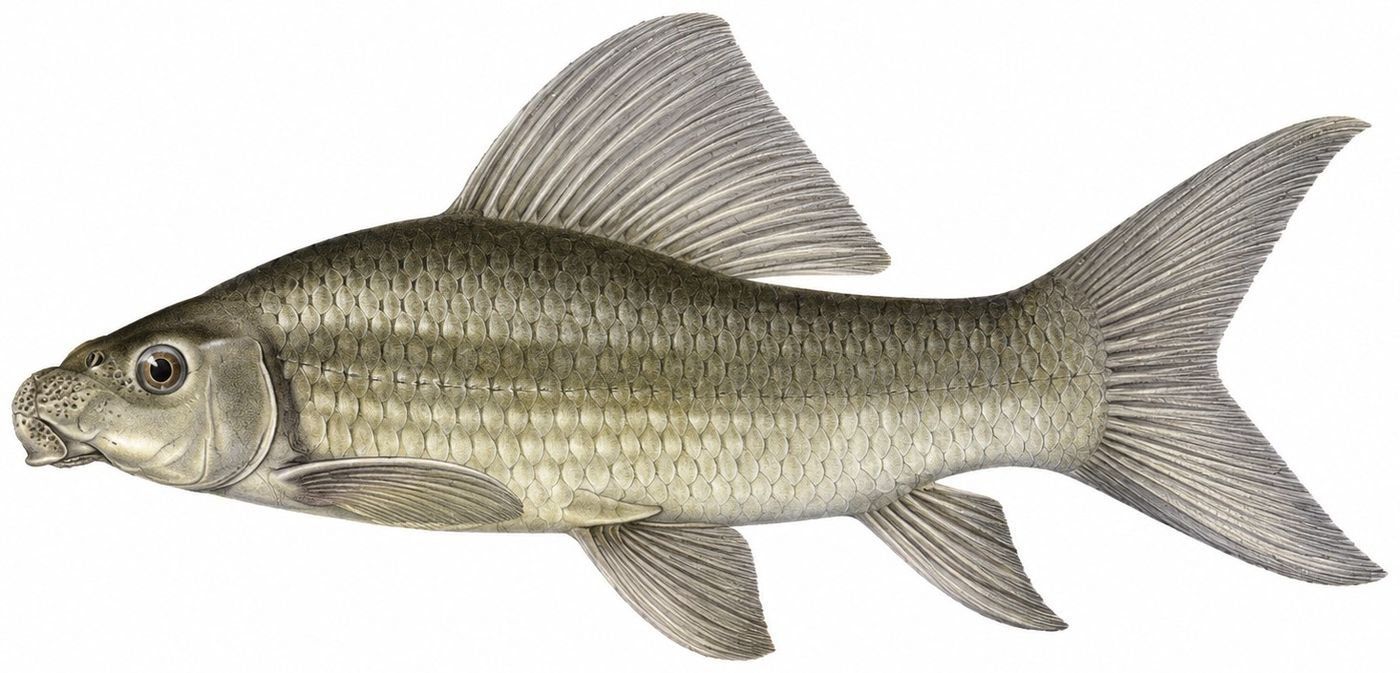
A cyprinid with a spindle-shaped, sturdy body, grey-bronze with a dark back, fleshy prominent snout overhanging an inferior sucker mouth with thick, fringed lips. Large dorsal fin; powerful forked caudal. The outline of a slender “carp” of the currents.
Features that never mislead
Inferior sucker mouth with fleshy lips (grazing on the substrate).
Prominent, rounded snout; streamlined grey-bronze body.
Large dorsal fin; forked caudal of a strong swimmer.
No developed barbels (unlike catfishes).
Size and weight
Usually 25 to 45 cm; published maximum around 80 cm for several kilos.
Behaviour and ecology
A grazer of hard bottoms: it scrapes algae, biofilm and micro-organisms from rocks and stumps in the current with its sucker mouth. A good swimmer, it frequents lively, oxygenated areas and makes spawning movements when the water rises.
Reproduction and season
Oviparous; spawns in the rainy season, often after migrating upstream or into flooded areas; abundant spawning in running water.
Fishing practice
Techniques, from most to least effective
Bottom line with plant paste or worm, near hard bottoms. The top technique.
Float fishing with plant-based groundbait in adjacent calm areas.
Cast net and net in subsistence fishing.
A fine fighter thanks to its muscles and the current: strong runs and sustained resistance. Small sucker mouth: fine hook, delicate strike. Easy to handle, no dangerous spines.
Eating quality
Popular white flesh but rather bony, as is often the case with cyprinids; eaten grilled, fried or smoked, especially in river areas.
Sources: FishBase (Labeo coubie, Rüppell 1832); IUCN Red List (Least Concern); Lévêque & Paugy. Local names to be documented.