
Atlantic bonito
Sarda sarda (Bloch, 1793)
Family Scombridae • the hunting bonito of coastal waters
1 look-alike to know
| French name | Bonite à dos rayé. |
|---|---|
| Scientific name | Sarda sarda (Bloch, 1793) |
| Family | Family Scombridae |
| English name (FAO) | Atlantic bonito |
| Local names | On Ivorian markets and landing sites: “Assaf” (Ouattara et al., 2016). |
| Habitat | Gregarious epipelagic predator, a surface hunter that forms spectacular hunting schools on small baitfish. |
| IUCN status | LC Least Concern. See main text of the sheet. |
Identification
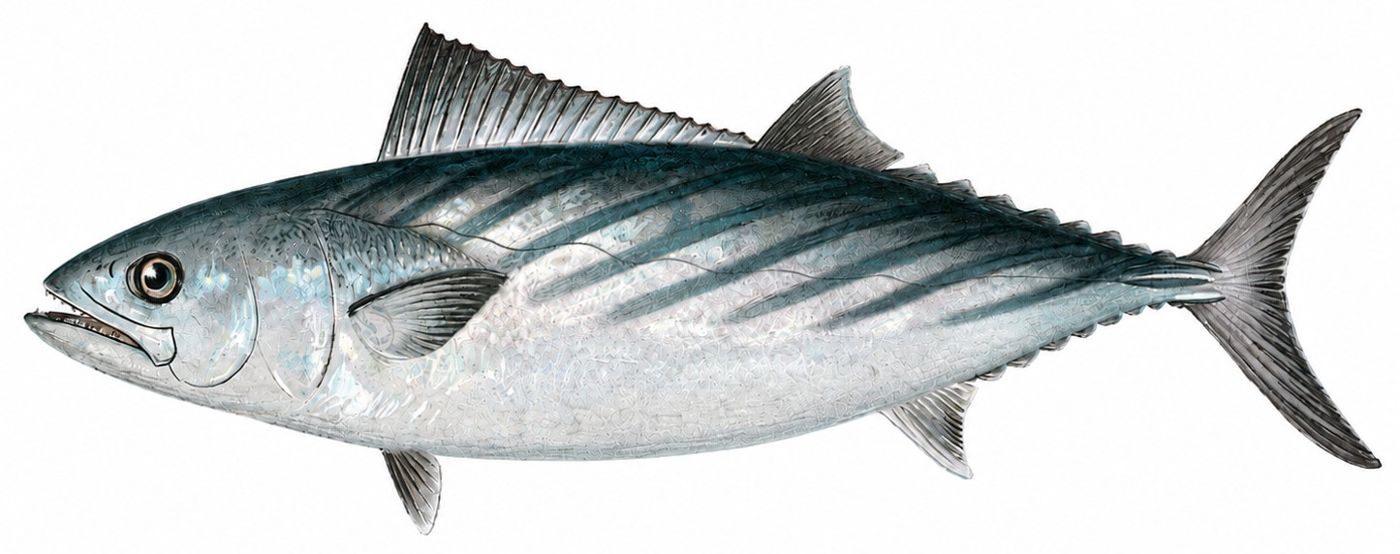
Compact fusiform body, oval in cross-section, pointed snout and wide mouth armed with visible conical teeth. Steel-blue back crossed by sharp dark oblique stripes rising towards the rear, the hallmark of the genus. Silvery flanks and belly without spots. Long, low first dorsal fin followed by a row of finlets; powerful forked tail. It differs from the Spanish mackerel by its oblique dorsal stripes instead of lateral spots, and from the small Auxis and Euthynnus tunas by the position and length of the first dorsal fin.
Features that never mislead
Dark oblique stripes on the back, more steeply angled than in any other Atlantic bonito.
Well-developed conical teeth on the jaws, rare in true tunas.
Long, low first dorsal fin, continuous to above the pectoral fins.
Corselet of thick scales behind the head, rest of body with fine scales.
Size and weight
Common size around 50 cm. Published maximum length about 91 cm fork length, with a maximum weight of around 11 kg (FishBase). Maturity is reached at about 38 to 41 cm.
Behaviour and ecology
Gregarious epipelagic predator, a surface hunter that forms spectacular hunting schools on small baitfish. Adults are sometimes cannibalistic and swallow relatively large prey: sardinellas, anchovies, squid, shrimps.
A tolerant species, able to withstand temperatures of 12 to 27 degrees and salinities of 14 to 39, it readily enters estuaries and mixing zones such as the mouth of the Vridi canal. Present along the entire Atlantic coast of Africa, and from Norway to South Africa. IUCN status of Least Concern, with a stable trend at the 2021 assessment, but of high commercial value and a target of industrial fishing.
Reproduction and season
Spawns in open water, pelagic eggs and larvae. A fast-growing, short-cycle species, about 2.5 years per generation, which gives it good resilience to fishing.
Fishing practice
Techniques, from most to least effective
By fast trolling of small shiny lures or wobbling spoons, on feeding frenzies spotted by the birds.
With surface lures cast into the frenzy, stickbait or light popper: very lively sport fishing.
With live bait or drifted fish strips at current spots at canal mouths.
The fight: a fast and explosive fighter for its size, with nervy runs and sudden changes of direction. Great fun on light spinning tackle.
Eating quality
Dark red, firm flesh with a pronounced, tuna-like taste. Good grilled, in sauce or marinated. Must be bled and chilled quickly, otherwise the flesh spoils. Possible ciguatera risk in some tropical areas; take care with very large fish.
Sources: FishBase (Sarda sarda, Bloch 1793); IUCN Red List 2021, LC; FAO Scombrids of the World, Collette and Nauen 1983; Ouattara et al. 2016.