
Swordfish
Xiphias gladius Linnaeus, 1758
Family Xiphiidae • the solitary sword-bearer of the deep
| French name | Espadon. |
|---|---|
| Scientific name | Xiphias gladius Linnaeus, 1758 |
| Family | Family Xiphiidae |
| English name (FAO) | Swordfish |
| Local names | On Ivorian markets and landing sites: “Poisson épée” (Ouattara et al., 2016). |
| Habitat | A large, solitary oceanic pelagic predator that hunts from the surface down to more than 500 m, and exceptionally much deeper. |
| IUCN status | NT Near Threatened. See main text of the sheet. |
Identification
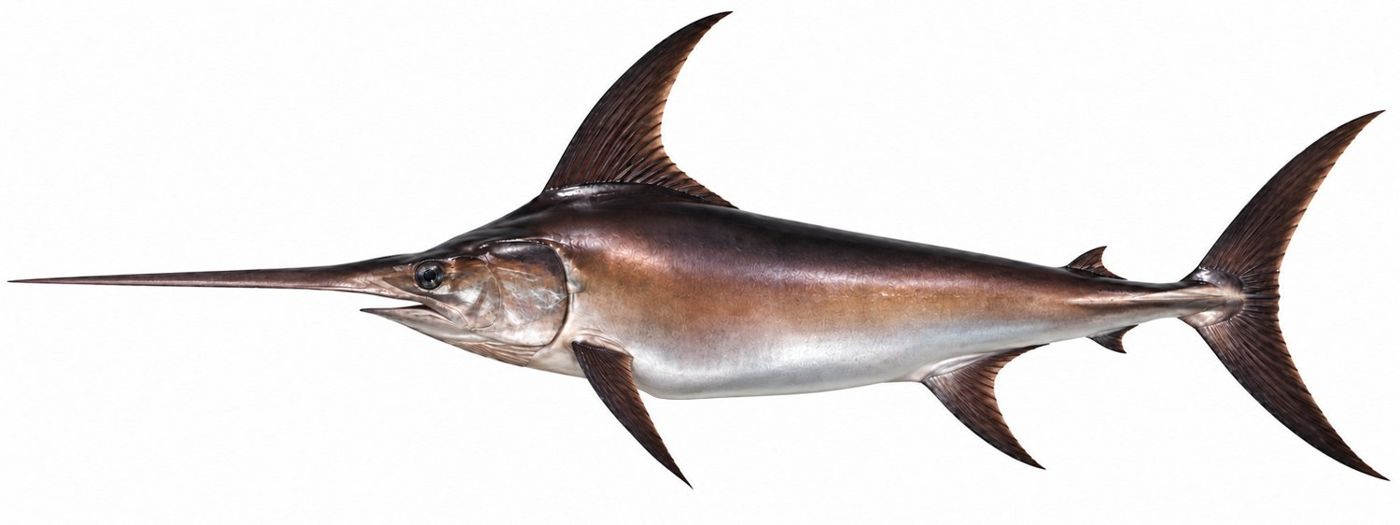
Elongated, round and powerful body, with no pelvic fins at all, a feature that immediately separates it from marlins and sailfish. The bill, long and flattened like a sabre blade, takes up nearly a third of its length and gives it its name. High, sickle-shaped first dorsal fin, well separated from a tiny second one. Large eyes. Brownish-black back turning paler on the flanks. Adults lose their teeth and scales. It differs from the Istiophoridae, marlins and sailfish, by the absence of pelvic fins and a longer, flatter bill.
Features that never mislead
Long bill flattened like a blade, up to a third of the body length.
No pelvic fins, unlike marlins and sailfish.
High, sickle-shaped first dorsal fin, clearly separated from the very small second one.
Adults without teeth or scales, very large eyes.
Size and weight
Common size around 3 m. Published maximum length about 4.55 m, with a maximum weight of around 650 kg (FishBase). Females are larger than males. Most Ivorian catches range from 20 to 100 kg.
Behaviour and ecology
A large, solitary oceanic pelagic predator that hunts from the surface down to more than 500 m, and exceptionally much deeper. A mainly nocturnal hunter, it slashes its prey, fish and squid, with a blow of its bill to stun them before swallowing them.
A highly migratory species, present in all tropical and temperate waters, able to tolerate cool water thanks to an organ that warms its brain and eyes. Off Côte d’Ivoire it is mainly caught by drifting longlines and, more rarely, in night sport fishing. IUCN status Near Threatened, May 2021 assessment: a high-value species under pressure from longlining, managed by ICCAT in the Atlantic.
Reproduction and season
Spawns in warm open water, in the surface layer; pelagic eggs and larvae. Late maturity, at around 1.5 to 2 m. Otolith growth rings are hard to read, so age is estimated from fin rays.
Fishing practice
Techniques, from most to least effective
Night drifting with bait. This is the classic sport method for swordfish, which rise towards the surface at night to feed. Several lines are set at staggered depths, from about 30 to 120 m, each with a whole squid and a lightstick or strobe. The boat drifts slowly, at 0.5 to 1.5 knots, and the baits are checked often.
Daytime deep-dropping. By day, swordfish stay near the bottom, at about 430 to 550 m on the slopes of the continental edge: they are fished there with a single weighted line, lowered with an electric reel. The technique is demanding but very effective, and it is practised in broad daylight.
Night drifting longline. This is the main commercial method off Côte d’Ivoire; it does not concern the sport angler, but it accounts for most of the swordfish sold in the markets.
Deep weighted trolling, less common, for active fish spotted near the surface.
The deep-drop rig, piece by piece
- Main line: 65 to 80 lb braid (30 to 36 kg), thin enough to hold the bottom despite the current.
- Wind-on leader in 250 to 400 lb monofilament (115 to 180 kg).
- 4.5 to 7 kg weight, attached with a loop of 20 to 25 lb breakaway line: the weight drops off during the fight and the fish is played without it.
- One or two strobes or lightsticks, a few metres above the bait.
- 9/0 to 11/0 circle hook, or 10/0 to 11/0 J-hook depending on the school.
- Bait: belly strip of bonito, little tunny or dolphinfish, or squid, always sewn onto the hook, as swordfish strike the bait several times before swallowing it.
The right moves
At depth, the bite is subtle: watch the rhythm of the rod tip with the swell, and every change counts. At the bite, drop quickly back to the bottom so the fish commits; if the line goes slack, reel, as swordfish often swim up with the bait. Set the drag at about 9 kg with the weight, up to 14 kg if needed, then reduce it once the weight has dropped off.
The fight: a legendary big-game opponent, with deep runs, blows of the bill and powerful jumps. Renowned for its stamina and fighting spirit, it demands heavy tackle.
Eating quality
White to pinkish flesh, firm and dense, close-grained and almost boneless. Excellent as grilled or pan-fried steaks. Watch the mercury content of very large fish, as with all long-lived large predators.
Deep demersal species | Supplementary sheet
Sources: FishBase (Xiphias gladius, Linnaeus 1758); IUCN Red List 2021, Near Threatened; FAO Billfishes of the World, Nakamura 1985; ICCAT; Ouattara et al. 2016. Fishing techniques and rigs (2026): ICCAT Recommendations 15-03 (South Atlantic swordfish), 16-11 (sailfish) and 19-05 (marlins); On The Water, “Daytime Swordfish”; West Marine, “How to Catch Swordfish”; AFTCO, “Best Marlin Lure Spread”, Captain Peter B. Wright; George Poveromo, “Types of Trolled Ballyhoo Rigs” (accessed 26/10/2026).