
Merlu
Merluccius polli Cadenat, 1950
Family Merlucciidae • the silvery gadiform of the continental slope
Identification
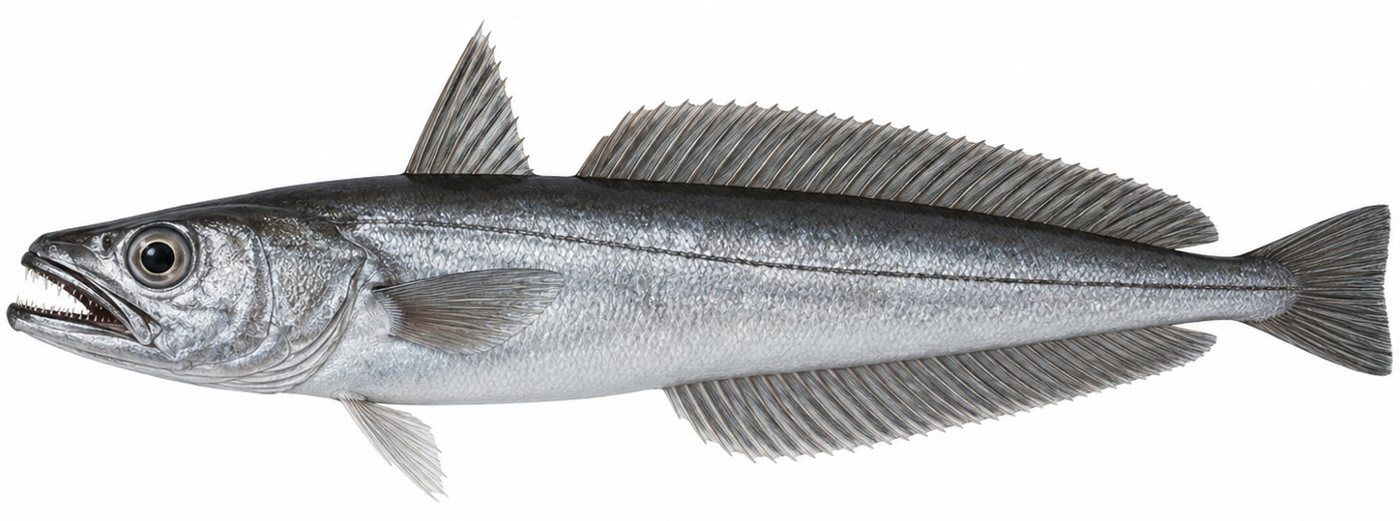
Elongated, slender and slightly compressed body with a silvery appearance. Large head with a broad snout, a large terminal mouth with a protruding lower jaw, armed with several rows of strong teeth. Two dorsal fins, the first short and triangular, the second long and low, running almost to the tail; a matching long anal fin; a small truncated tail clearly separated from both these fins. Slate-grey to blackish back, silvery flanks with a metallic sheen, white belly, black inside of the mouth, dark and well-marked lateral line. It differs from the Senegalese hake, Merluccius senegalensis, by the number of gill rakers and the position of the anus.
Features that never mislead
Two distinct dorsal fins: a short, triangular first one and a long, low second one reaching the tail.
Large terminal mouth, protruding lower jaw, black inside and strong, pointed teeth.
Small, truncated tail, well separated from the second dorsal and anal fins.
Silvery body, slate-grey back, very visible dark lateral line.
Size and weight
Common size 30 to 60 cm, published maximum length around 1 m for a few kilos. Females grow larger than males. Most Ivorian catches range from 30 to 50 cm.
Behaviour and ecology
A demersal to benthopelagic fish of the continental slope, living mainly between 100 and 700 m deep over mud and muddy sand. An active predator that hunts fish (sardinellas, anchovies, small gobies), cephalopods and crustaceans, rising into the water column at night to feed.
Found from Mauritania to Angola, abundant off the countries of the Gulf of Guinea. Off Côte d’Ivoire it is mainly caught by deep-water trawlers working the slope, more rarely by bottom longline. An important resource for industrial fishing, sensitive to the pressure of deep-water trawling; IUCN status to be confirmed for the region.
Reproduction and season
Spawns in deep water, spread over much of the year with one or two peaks linked to the rising of cold water (upwelling). Pelagic eggs and larvae. Maturity reached at around 25 to 35 cm.
Fishing practice
Techniques, from most to least effective
Deep-water bottom trawling on the slope, the dominant commercial method.
Baited bottom longline (sardine or squid), set on deep muddy grounds.
Weighted bottom line, more marginal, for fish active at night.
Its interest: above all a commercial species, little sought after in sport fishing because it lives so deep. Its value lies in the quality of its flesh, appreciated more on the fish stall than at the end of the line.
Eating quality
White, fine, tender, melting flesh with a delicate grain and few bones. Excellent as baked, poached or breaded fillets, and the basis of many dishes. Freezes well but spoils quickly when chilled: eat promptly.
Sources: FishBase (Merluccius polli, Cadenat 1950); FAO Species Catalogue, Gadiform Fishes of the World, Cohen et al. 1990; Centre de Recherches Océanologiques (CRO), Abidjan; IUCN Red List.