
Blue runner
Caranx crysos (Mitchill, 1815)
Family Carangidae • the blue runner of coastal schools
1 look-alike to know
| French name | Carangue coubali. |
|---|---|
| Scientific name | Caranx crysos (Mitchill, 1815) |
| Family | Family Carangidae |
| English name (FAO) | Blue runner |
| Local names | On Ivorian markets and landing sites: “Japon-noir” (Ouattara et al., 2016). |
| Habitat | A gregarious predator that forms fast schools, mainly over reefs and structures, and readily gathers around objects and platforms at s |
| IUCN status | LC Least Concern. See main text of the sheet. |
Identification
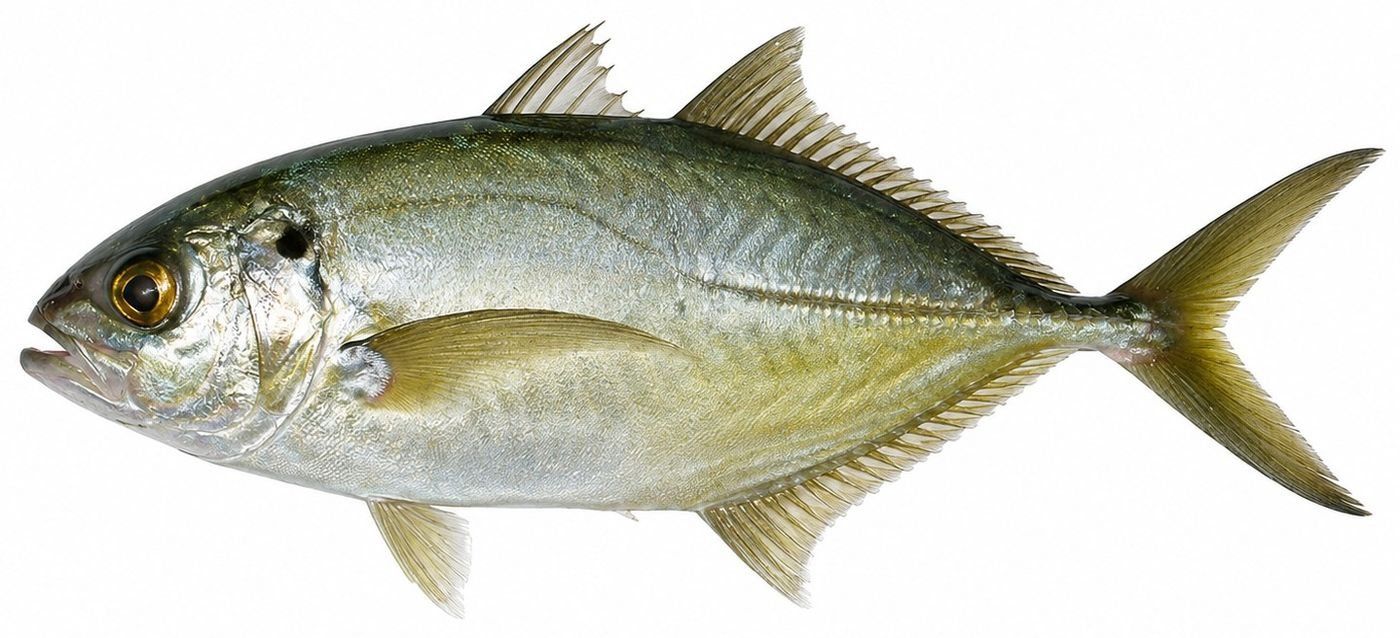
A medium-sized jack with an elongated, moderately compressed body, dorsal and ventral profiles equally convex, and a slightly pointed snout. Green-blue to olive back, silvery flanks sometimes marked with a fine yellow line, pale belly. Caudal peduncle armed with sharp scutes, as in all true jacks. Juveniles often have seven dark vertical bars that fade with age. It differs from the crevalle jack, Caranx hippos, by its slimmer silhouette, the lack of such a marked gill-cover spot and a less rounded forehead.
Features that never mislead
Body slimmer than the crevalle jack, dorsal and ventral profiles equally convex.
Caudal peduncle armed with sharp scutes, the hallmark of Caranx.
Juveniles with seven dark vertical bars that disappear in adults.
Second dorsal, anal and tail fins sometimes washed with yellow.
Size and weight
Common size under 35 cm. Confirmed maximum length about 70 cm, with a maximum weight of around 5 kg (FishBase). Maximum reported age around 11 years.
Behaviour and ecology
A gregarious predator that forms fast schools, mainly over reefs and structures, and readily gathers around objects and platforms at sea. It hunts small fish in coastal waters, while offshore fish feed more on zooplankton. Juveniles live in open water, often under rafts of sargassum or near jellyfish.
Found throughout the Atlantic, from Senegal to Angola on the eastern side, including the western Mediterranean. On the Ivorian coast it frequents the shoreline and the mouth of the Vridi canal. IUCN status of Least Concern, stable assessment: an abundant species, exploited in mixed fisheries and widely used as live bait.
Reproduction and season
Spawns in open water offshore, all year round with a peak in the warm season. Matures between 22 and 28 cm. Pelagic larvae and juveniles under sargassum.
Fishing practice
Techniques, from most to least effective
With cast lures, jigs or diving plugs, on schools feeding at the surface.
By fast trolling of small spoons along the coast and around structures.
With live bait and fish strips at current spots.
The fight: nervy and tireless for its size, with the repeated runs typical of jacks; great fun on light spinning tackle.
Eating quality
Firm, slightly red and dense flesh, decent without being fine, enjoyed braised or in sauce. Often used as live bait rather than as a table fish; eat fresh.
Sources: FishBase (Caranx crysos, Mitchill 1815); IUCN Red List 2009, LC, version 2025; FAO Western Central Atlantic; Ouattara et al. 2016.