
Senegal jack
Caranx senegallus Cuvier, 1833
Family Carangidae • the white jack of coastal waters
| French name | Carangue du Sénégal. |
|---|---|
| Scientific name | Caranx senegallus Cuvier, 1833 |
| Family | Family Carangidae |
| English name (FAO) | Senegal jack |
| Local names | On Ivorian markets and landing sites: “Japon-blanc” (Ouattara et al., 2016). |
| Habitat | A gregarious coastal predator that hunts small baitfish in schools along the shoreline and in the brackish waters of river mouths. |
| IUCN status | NE Not Evaluated / to be checked. |
Identification
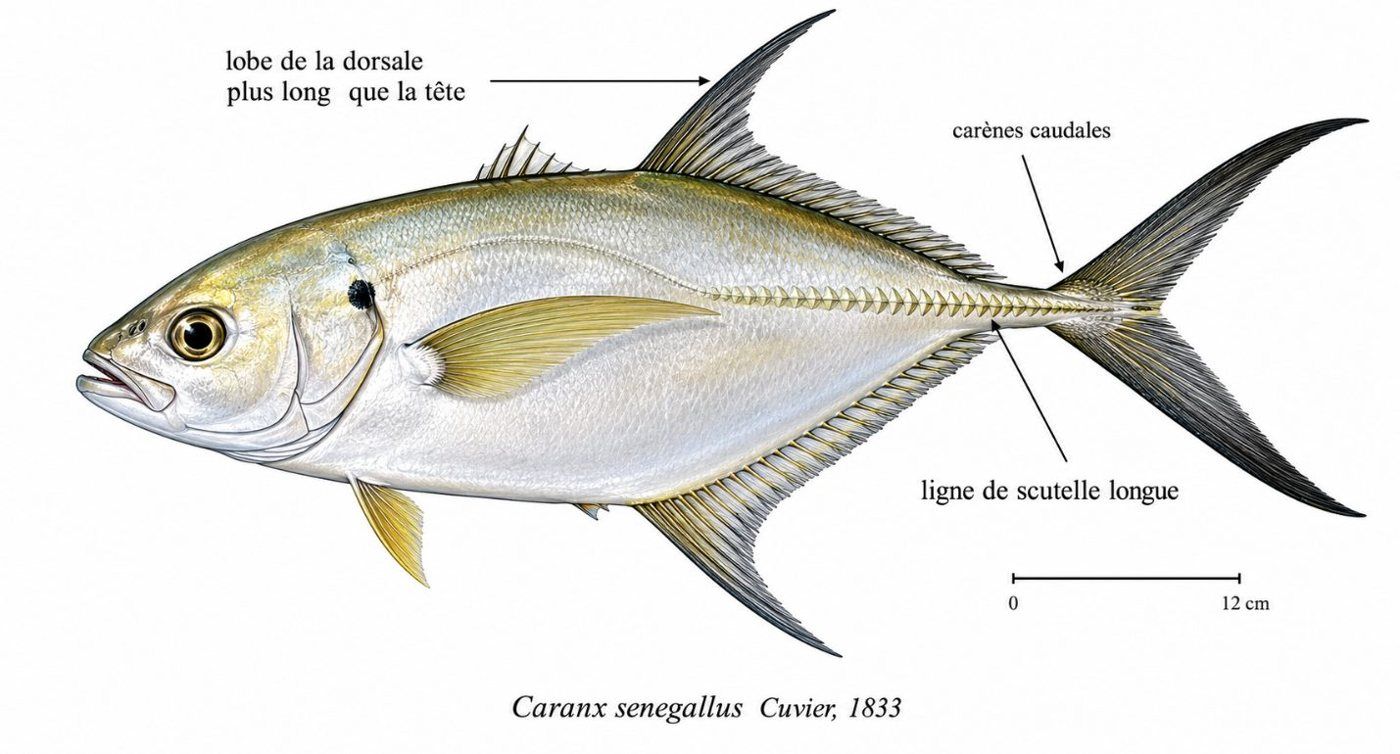
A large jack with an oval, moderately compressed body, a short blunt snout, a dorsal profile slightly more convex than the ventral one, and a silvery livery with pale reflections, hence its local name “Japon blanc” (‘white Japon’). Caudal peduncle armed with sharp scutes. It differs from the crevalle jack by its paler colouring and the lack of such a clear black gill-cover spot, and from the blue runner by its larger size and deeper body.
Features that never mislead
Pale silvery livery, without a marked black gill-cover spot.
Fairly deep oval body, short blunt snout.
Caudal peduncle armed with sharp scutes, the hallmark of Caranx.
Reaches a metre in length, larger than the blue runner.
Size and weight
Common size around 30 cm. Maximum known length of around 1 m (FishBase). Fine coastal fish exceed several kilos.
Behaviour and ecology
A gregarious coastal predator that hunts small baitfish in schools along the shoreline and in the brackish waters of river mouths. Typical jack chasing behaviour, with noisy surface feeding frenzies.
A species of the tropical Atlantic off West Africa. On the Ivorian coast it frequents the shoreline and the mixing zone of the Vridi canal, where it mingles with other jacks. IUCN status data to be checked for this species, which is less well documented than C. hippos or C. crysos.
Reproduction and season
Spawns in coastal open water; pelagic eggs and larvae, mainly in the warm season.
Fishing practice
Techniques, from most to least effective
With surface lures and jigs cast into feeding frenzies, as for the crevalle jack.
With live bait at current spots and river mouths.
By trolling shiny lures along the coast.
The fight: powerful and stubborn, with the heavy runs typical of large jacks; a fine fighter on spinning tackle.
Eating quality
Firm, decent flesh, enjoyed braised or in sauce, common on Ivorian markets. Eat fresh.
Sources: FishBase (Caranx senegallus, Cuvier 1833); FAO Eastern Central Atlantic; Ouattara et al. 2016.