
Cunene horse mackerel
Trachurus trecae Cadenat, 1950
Family Carangidae • the scad of coastal schools
4 look-alikes to know
| French name | Chinchard noir. Other names: chinchard du Cunène, saurel, carangue (local usage). |
|---|---|
| Scientific name | Trachurus trecae Cadenat, 1950 |
| Family | Family Carangidae |
| English name (FAO) | Cunene horse mackerel |
| Local names | On Ivorian markets and landing sites: “Appolo noir” (Ouattara et al., 2016). |
| Habitat | Marine and brackish, benthopelagic. Depth 20 to 100 m, sometimes deeper. |
| IUCN status | LC Least Concern. Eastern Atlantic: Morocco to Angola. |
Identification
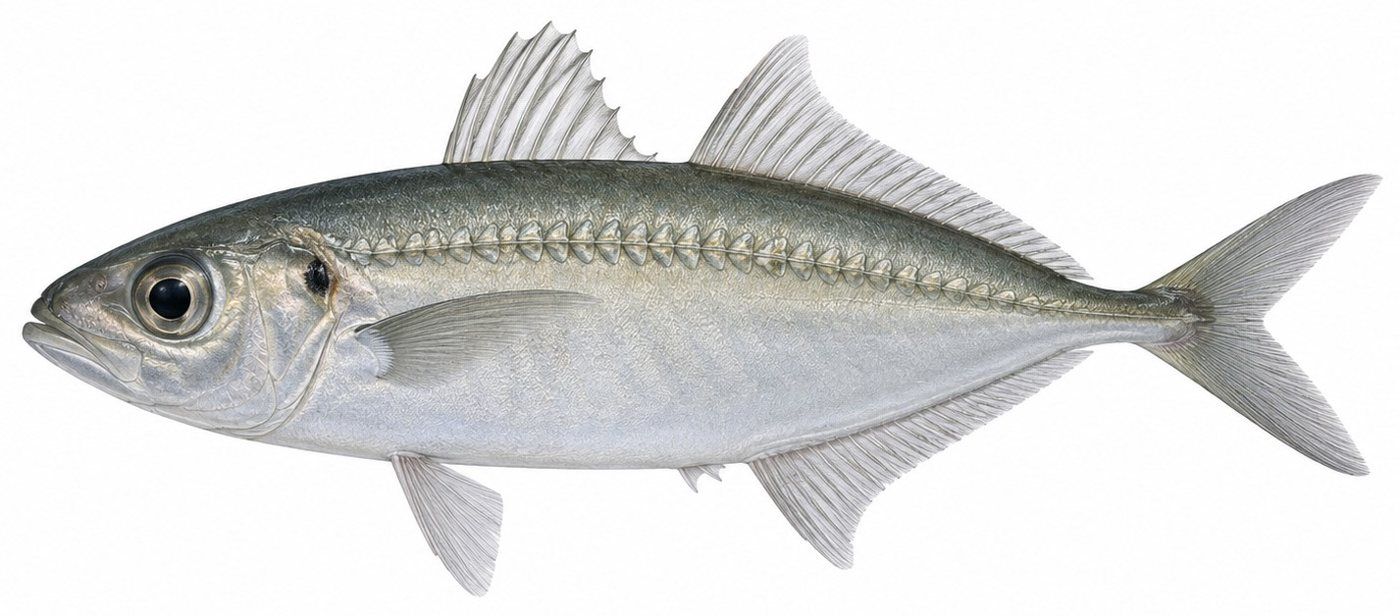
Streamlined, compressed body, grey-blue back, silvery flanks and belly. Large eye. The lateral line, characteristic of horse mackerels, is armed with bony scutes along its entire length, most pronounced on the straight rear section.
Features that never mislead
- Lateral line lined along its whole length with sharp bony scutes.
- Dark spot on the upper edge of the gill cover.
- Two dorsal fins, streamlined body of a schooling swimmer, large eye.
- Modest size, rarely more than 35 cm.
Size and weight
Published maximum length 35 cm (FL), with a maximum weight of about 2 kg (FishBase). Maturity at about 24 cm. On the Ivorian coast, typical catches are between 0.2 and 0.5 kg.
Behaviour and ecology
A gregarious fish forming large, tight schools near the bottom by day, sometimes rising to the surface. It feeds mainly on planktonic crustaceans, small fish and larvae. A key species in the coastal food chain and forage for large predators.
Off Côte d’Ivoire it is an abundant species on the shelf, closely tied to the Guinean upwelling and a mainstay of both industrial and artisanal fishing.
Reproduction and season
Spawns at sea over a long season. High fecundity. Biomass fluctuates with the strength of the upwelling and regional fishing pressure.
Fishing practice
Techniques, from most to least effective
- With a string of feathers or small lures (sabiki) on spotted schools, the top technique for this schooling fish.
- With a light multi-hook handline and cut bait.
- With purse seines and nets in subsistence and commercial fishing.
On light tackle, each horse mackerel pulls honestly, and the sabiki multiplies the thrills when 3 or 4 fish come up together. Handle with care: the scutes on the lateral line cut fingers.
Eating quality
Tasty but delicate flesh, to be eaten very fresh: excellent grilled, fried, or fried whole for small fish. Very popular smoked or dried in the subregion. Bleeding and icing quickly makes a marked difference to quality.
Did you know?
The row of bony scutes along the horse mackerel’s lateral line is not just armour: these scutes stiffen the rear of the body and channel the water, helping this small fish keep its place in schools of several thousand individuals that turn as a single organism to confuse predators.
Sources: FishBase (Trachurus trecae, Cadenat 1950); IUCN Red List 2015 (Least Concern); FAO Ressources halieutiques Sénégal-Gambie; WoRMS. Ivorian data to be reconfirmed with the CRO Abidjan.