
Longfin pompano
Trachinotus goreensis Cuvier, 1832
Family Carangidae • the large diamond-shaped pompano of West Africa
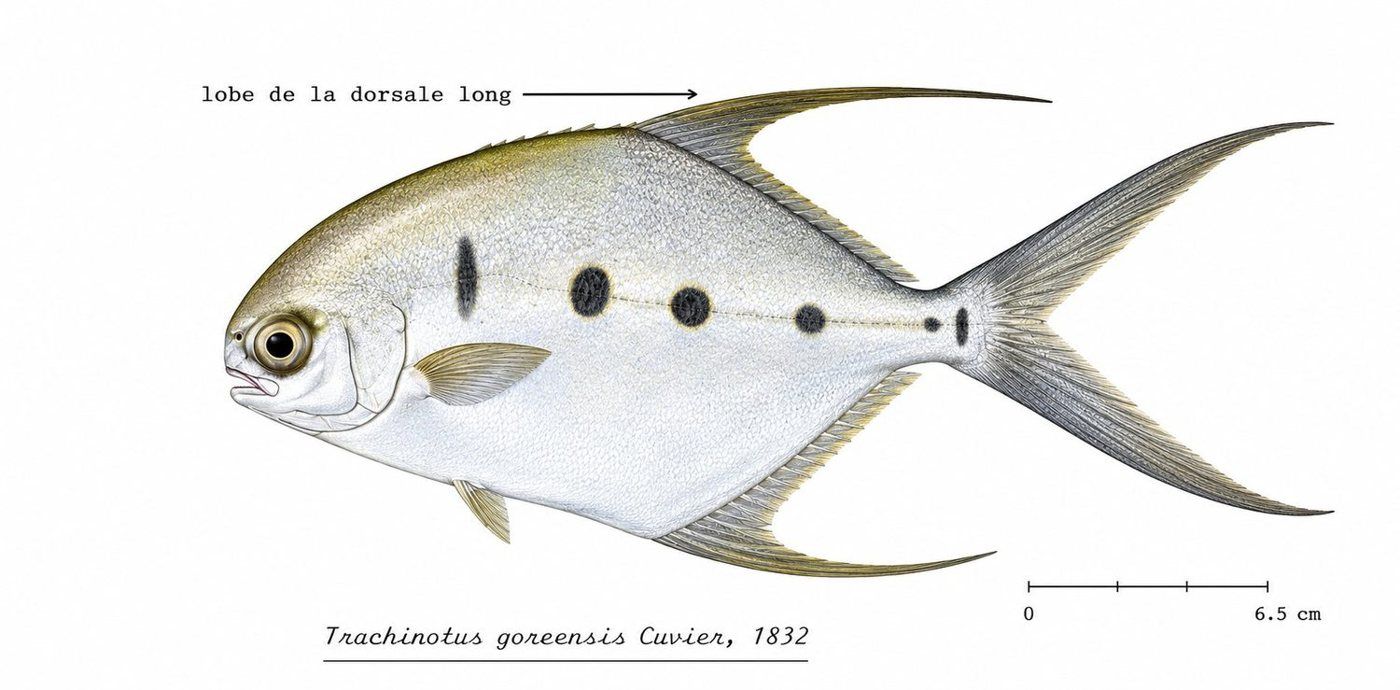
| French name | Pompaneau à longues nageoires. |
|---|---|
| Scientific name | Trachinotus goreensis Cuvier, 1832 |
| Family | Family Carangidae |
| English name (FAO) | Longfin pompano |
| Local names | On Ivorian markets and landing sites: “Arraie” (Ouattara et al., 2016). |
| Habitat | A coastal and lagoon species that frequents the shoreline and ranges widely into the brackish waters of river mouths and lagoons, over sandy and muddy bottoms, down |
| IUCN status | NE Not Evaluated / to be checked. |
Identification
A pompano with a short, deep, diamond-shaped and strongly compressed body, a rounded forehead and rounded snout. Silvery livery with bluish reflections. It is recognised above all by its dorsal and anal fin lobes, clearly longer and more sickle-shaped than those of the shortfin pompano, Trachinotus teraia, hence its name of longfin pompano. No scutes on the lateral line. The upper jaw reaches almost to below the rear edge of the eye.
Features that never mislead
Long, sickle-shaped dorsal and anal fin lobes, more so than in T. teraia.
Short, deep, diamond-shaped body, rounded forehead and snout.
No scutes on the lateral line, unlike Caranx.
Silvery livery with bluish reflections, without marked bars in adults.
Size and weight
Common size around 30 cm. Maximum length about 60 cm total length (FishBase). Fine lagoon fish exceed several kilos.
Behaviour and ecology
A coastal and lagoon species that frequents the shoreline and ranges widely into the brackish waters of river mouths and lagoons, over sandy and muddy bottoms, down to about a hundred metres. It feeds on molluscs, worms and small benthic crustaceans.
Present on the West African coast, from Senegal to the Congo estuary. In Côte d’Ivoire it shares the waters of the Ébrié lagoon and the Vridi canal with the shortfin pompano. Local IUCN status data to be checked.
Reproduction and season
Spawns in coastal open water; pelagic eggs and larvae. Young fish use lagoons and estuaries as nurseries.
Fishing practice
Techniques, from most to least effective
Bottom fishing with natural bait (worm, crab, shellfish) over lagoon bottoms.
Surfcasting from the beaches and the canal mouth.
With soft plastic lures worked close to the bottom for active fish.
The fight: combative and stubborn for its size, with sustained runs; much appreciated on light spinning tackle in the lagoon, like its cousin teraia.
Eating quality
White, firm and fine flesh, excellent grilled or braised, among the best of the lagoon fish. Eat fresh.
Sources: FishBase (Trachinotus goreensis, Cuvier 1832); FAO Eastern Central Atlantic; Ouattara et al. 2016.