
Guinean barracuda
Sphyraena afra (Peters, 1844)
Family Sphyraenidae • the armoured torpedo of the channels
2 look-alikes to know
| French name | Barracuda de Guinée, bécune de Guinée. Other names: grand barracuda d’Afrique, brochet de mer. |
|---|---|
| Scientific name | Sphyraena afra (Peters, 1844) |
| Family | Family Sphyraenidae |
| English name (FAO) | Guinean barracuda |
| Local names | On Ivorian markets and landing sites: “Brochet” (Ouattara et al., 2016). |
| Habitat | Marine, coastal, estuaries and coastal lagoons. Continental shelf down to about 75 m. |
| IUCN status | Least Concern (LC), IUCN Red List, assessed on 14/07/2014. Very low resilience: releasing large breeders is recommended. Species targeted by West African artisanal fisheries, under local pressure. |
How to recognise it
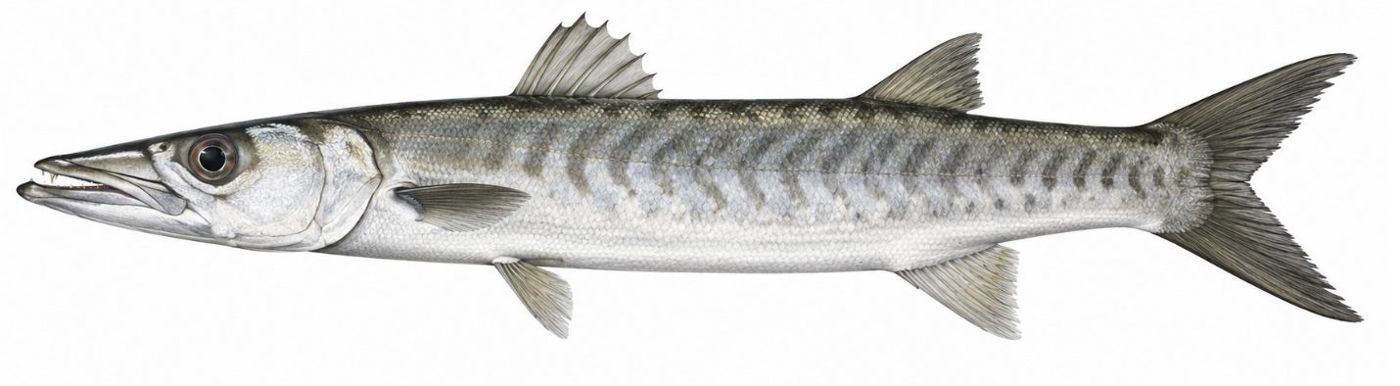
- very elongated, almost cylindrical body, long head, protruding lower jaw armed with fang-like teeth;
- two widely separated dorsal fins (6 spines, then 9 soft rays); anal fin with 2 spines and 9 rays;
- about 20 dark chevrons on the flanks, silvery white belly;
- lateral line with 122 to 140 scales.
Not to be confused with: the Guachanche barracuda (Sphyraena guachancho), which is smaller (separation criteria to be documented).
Size
Common size 100 cm; published maximum 205 cm and 50 kg (FishBase).
Life
A predator of fish and shrimps, lying in wait in channels, river mouths and near structures; adults often solitary. Very low resilience: the population is slow to recover (FishBase). Known from Abidjan, estuaries and coastal lagoons.
Fishing
With fast lures (stickbait, long jerkbait, silver jig); by trolling a long diving plug; with live bait (sardinella, mullet) at current spots for large fish. Wire or heavy fluorocarbon leader. Handle with pliers: sharp teeth (species classed as traumatogenic by FishBase).
At the table
White flesh, enjoyed grilled or braised. A good eating fish (FishBase).
Status
Least Concern (LC), IUCN Red List, assessment of 14/07/2014 (via FishBase, checked on 24/10/2026). Very low resilience: releasing large breeders is recommended.
Sources: FishBase, Sphyraena afra and Sphyraena barracuda (accessed on 24/10/2026); species sheet 25 V13.