
Guachanche barracuda
Sphyraena guachancho Cuvier, 1829
Family Sphyraenidae • the small schooling barracuda of murky waters
1 look-alike to know
| French name | Bécune guachanche. |
|---|---|
| Scientific name | Sphyraena guachancho Cuvier, 1829 |
| Family | Family Sphyraenidae |
| English name (FAO) | Guachanche barracuda |
| Local names | On Ivorian markets and landing sites: “Brochet” (Ouattara et al., 2016). |
| Habitat | A gregarious predator of coastal and brackish waters, down to about a hundred metres. |
| IUCN status | LC Least Concern. See main text of the sheet. |
Identification
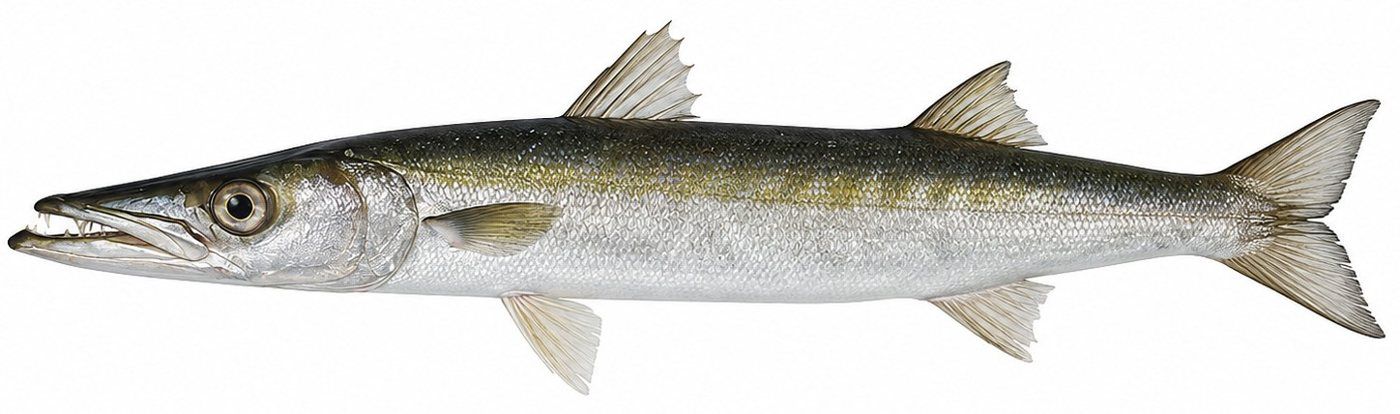
Very elongated, cylindrical, streamlined body, long pointed snout, protruding lower jaw armed with sharp, uneven teeth. Two well-separated dorsal fins. Grey-blue back, silvery flanks. Unlike the large Guinean barracuda, Sphyraena afra, the flanks bear few or no marked dark chevrons. A smaller, more gregarious and more coastal species. Straight, well-marked lateral line, 102 to 119 scales.
Features that never mislead
Slim, cylindrical body, long snout, protruding lower jaw.
Silvery flanks without marked chevrons, unlike Sphyraena afra.
Two widely separated dorsal fins, last rays of the dorsal and anal fins elongated.
Sharp, uneven teeth, straight and clear lateral line.
Size and weight
Common size around 70 cm. Published maximum length about 200 cm total length, but fish over a metre are rare, with a maximum recorded weight of around 1.8 kg (FishBase).
Behaviour and ecology
A gregarious predator of coastal and brackish waters, down to about a hundred metres. It hunts small baitfish in schools, anchovies and sardinellas, often in the murky, sediment-laden waters of river mouths and estuaries.
Present in the Eastern Atlantic from Senegal to Angola, including the Canary Islands and Cape Verde. On the Ivorian coast it frequents the turbid waters of the shoreline and the mouth of the Vridi canal, where it forms active schools. IUCN status of Least Concern.
Reproduction and season
Spawns in coastal open water; pelagic eggs and larvae. Matures from about 35 cm.
Fishing practice
Techniques, from most to least effective
With shiny cast lures, spoons or diving plugs, into schools that are feeding.
With live bait and fish strips at current spots and river mouths.
Light trolling along the coast.
The fight: lively and fast, with clean strikes and short, nervy runs; fun on light spinning tackle. Handle with care because of the teeth.
Eating quality
Decent white flesh, eaten fresh, grilled or in sauce. As with all barracudas, very large fish from reef areas may carry a risk of ciguatera, but the medium-sized coastal guachanche is commonly eaten.
Sources: FishBase (Sphyraena guachancho, Cuvier 1829); IUCN Red List, LC; Ouattara et al. 2016.