
Canary dentex
Dentex canariensis (Steindachner, 1881)
Family Sparidae • the pink sparid with the shoulder spot
2 look-alikes to know
| French name | Denté du Canaries. Other names: daurade rose, denté à tache rouge. |
|---|---|
| Scientific name | Dentex canariensis (Steindachner, 1881) |
| Family | Family Sparidae |
| English name (FAO) | Canary dentex |
| Local names | On Ivorian markets and landing sites: “Daurade” (Ouattara et al., 2016). |
| Habitat | Marine demersal, coastal waters near the bottom over varied substrates, mainly rocky, down to about 150 m. |
| IUCN status | LC Least Concern. An important food fish, exploited by commercial fishing. |
Identification
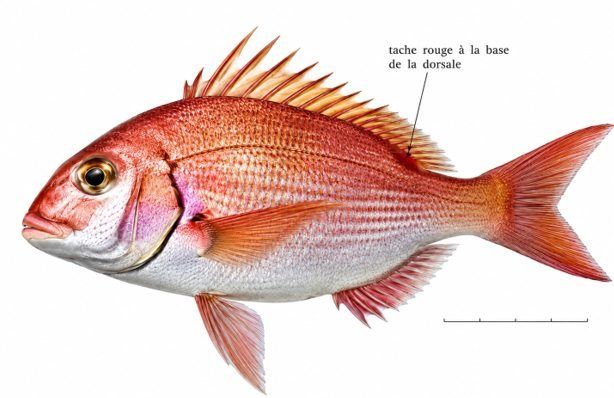
Oval body, laterally compressed, typical sparid profile. Silvery pink colouring with golden reflections, paler on the belly. Robust head, powerful mouth armed with strong teeth (hence the genus name, “dentex”). Eye set high on the head.
Features that never mislead
- Clearly visible red-orange spot directly above the origin of the pectoral fin (shoulder).
- Overall silvery pink colouring with golden reflections.
- Strong canine teeth at the front of the jaws, molar-like teeth at the back.
- Evenly rounded head profile, without a marked forehead hump in adults.
Size and weight
Published maximum length 100 cm (SL) for a maximum weight of about 8.1 kg (FishBase). Common size around 32 cm. Maturity reached from about 22 cm. On the Ivorian coast, typical catches are between 1 and 3 kg.
Behaviour and ecology
A bottom predator living in small groups, with large individuals becoming solitary. It frequents coastal waters near the bottom, with a marked preference for rocky substrates and breaks. Adults feed on fish, crustaceans and cephalopods; juveniles eat mainly plankton.
Off Côte d’Ivoire, it is a demersal species of the continental shelf, caught over hard bottoms and rock heads.
Reproduction and season
Coastal spawning. Early maturity (at around 22 cm). Like many sparids, the species may show hermaphroditism; the exact details remain to be clarified locally.
Fishing practice
Techniques, from most to least effective
1. With a handline or bottom line (paternoster) over rock heads and breaks, using natural bait (piece of fish, shrimp, cephalopod).
2. With a madai rubber jig / inchiku over rocky bottoms, a fine and effective technique for sparids.
3. Controlled drifting over hard bottoms, with the bait held near the bottom.
A clean bite followed by the fish heading for the rocky bottom: you must lift it away without delay to stop it taking refuge in the rocks and cutting the line. Drag set firm at the start, then play it gently once the fish is off the bottom.
Eating quality
Fine, firm white flesh, highly valued. Excellent baked whole, as pan-fried fillets, or braised. It is a sought-after table fish all along the West African coast.
Did you know?
The Canary dentex has a misleading name: despite its epithet “canariensis”, it is actually absent from the Canary Islands themselves. Its true range extends along the African mainland, from Western Sahara to Angola. Its red shoulder spot, bright against a silvery pink background, is its signature and also earns it the name “denté à tache rouge” (red-spot dentex).
Sources: FishBase (Dentex canariensis, Steindachner 1881); FAO Field Guide Gulf of Guinea (Schneider, 1990); IUCN Red List (Least Concern); Bauchot & Hureau 1990. Ivorian data to be reconfirmed with the CRO Abidjan.