
Pagre à points bleus (Bluespotted seabream)
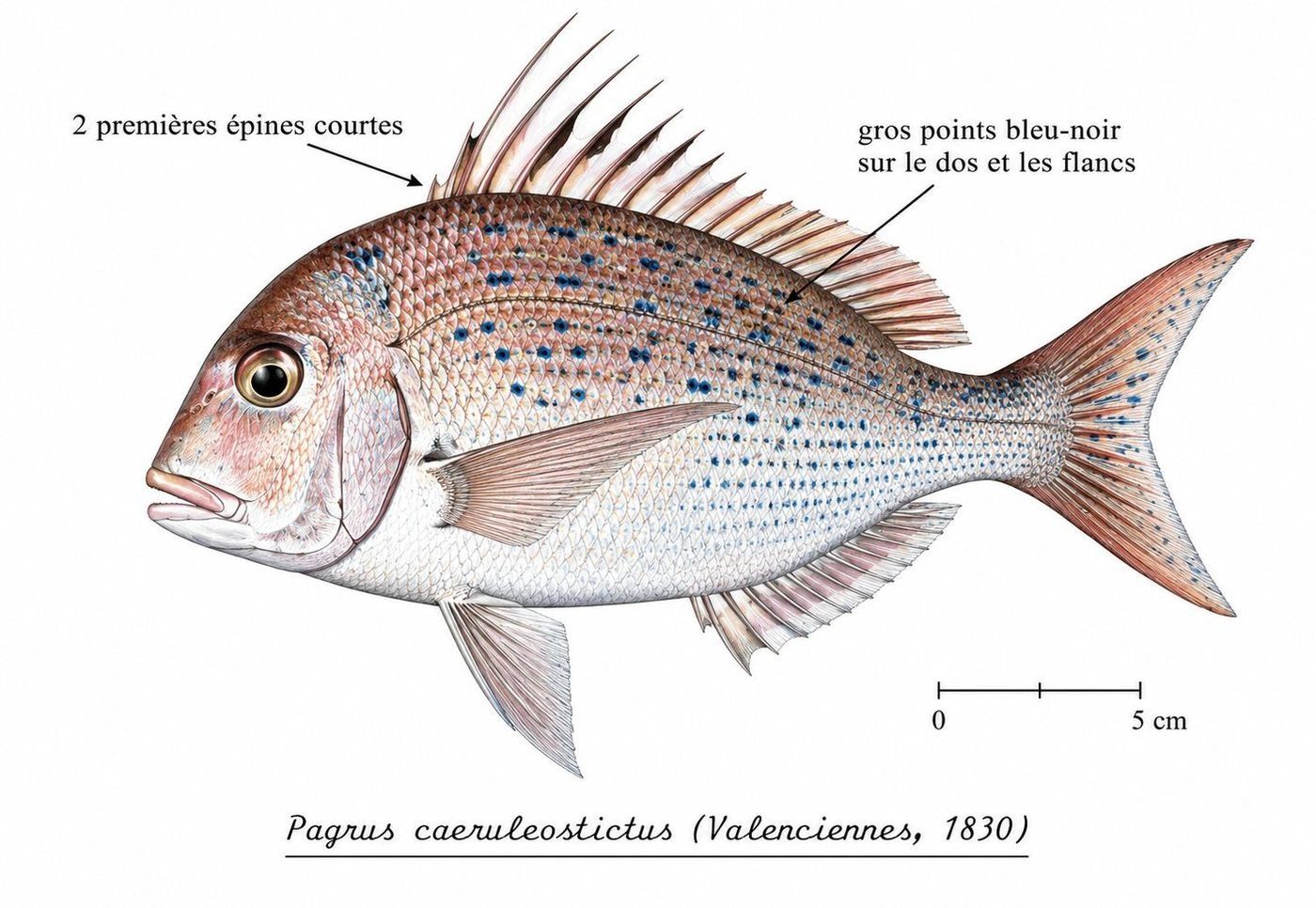
Pagrus caeruleostictus (Valenciennes, 1830)
Family Sparidae • the pink seabream speckled with blue
3 look-alikes to know
| French name | Pagre à points bleus. Other names: daurade rose, pagre bleué. |
|---|---|
| Scientific name | Pagrus caeruleostictus (Valenciennes, 1830) |
| Family | Family Sparidae |
| English name (FAO) | Pagre à points bleus (Bluespotted seabream) |
| Local names | On Ivorian markets and landing sites: “Daurade” (Ouattara et al., 2016). |
| Habitat | Marine and brackish, benthopelagic. Depth 1 to 200 m, most often 30 to 50 m, over hard bottoms. |
| IUCN status | DD Data Deficient. Overexploitation reported in Morocco, catch declines in Turkey. |
Identification
A handsome sparid with a deep, robust body and a rounded head profile. Silvery pink livery with golden reflections, dotted with small scattered blue spots on the upper flanks, most marked in young fish. Strong jaws, armed with crushing molars at the back and canines at the front. Forked tail fin with darker edges.
Features that never mislead
Small scattered blue spots on the upper pinkish flanks.
Deep, robust body, rounded forehead, profile of a large sparid.
Mixed teeth: canines at the front, crushing molars at the back.
Silvery pink livery with golden reflections.
Size and weight
Common size around 50 cm. Published maximum length about 90 cm standard length, for a maximum weight of around 11.6 kg (FishBase). On the Ivorian coast, good fish regularly exceed several kilos.
Behaviour and ecology
A demersal predator of hard bottoms, rocks and stony ground, where it crushes molluscs, crustaceans and small fish with its molars. Young fish live near the coast, adults move to deeper grounds at the edge of the shelf.
Present in the Eastern Atlantic from Portugal to Angola, including the Mediterranean and the Ivorian coast. A highly appreciated food fish, heavily targeted.
Reproduction and season
Protogynous hermaphrodite for the genus: sexual maturity at around 19 cm. Coastal spawning, pelagic eggs and larvae. Local spawning data to be confirmed with the CRO.
Fishing practice
Techniques, from most to least effective
Bottom fishing with natural bait (shrimp, squid, piece of fish) over hard bottoms.
Handline and tataki fishing on wrecks and rocky drop-offs.
Surfcasting from rock armour for coastal fish.
The fight: powerful and fierce, the seabream dives for the bottom on the bite. The strike must be firm to lift it away from the rocks where it seeks refuge.
Eating quality
White, firm and tasty flesh, among the most sought after of the sparids. Excellent baked, grilled or braised. Highly prized on Ivorian markets.
Sources: FishBase (Pagrus caeruleostictus, Valenciennes 1830); IUCN Red List 2011 (Data Deficient); FAO Eastern Central Atlantic; Ouattara et al. 2016.