
West African goatfish
Pseudupeneus prayensis (Cuvier, 1829)
Family Mullidae • the goatfish with the golden line
2 look-alikes to know
| French name | Rouget du Sénégal, rouget-barbet du Sénégal. Other names: rouget ouest-africain. |
|---|---|
| Scientific name | Pseudupeneus prayensis (Cuvier, 1829) |
| Family | Family Mullidae |
| English name (FAO) | West African goatfish |
| Local names | On Ivorian markets and landing sites: “Poisson crevette” (Ouattara et al., 2016). |
| Habitat | Marine demersal on the continental shelf, sandy and muddy bottoms. Depth 10 to 300 m, usually 20 to 75 m. |
| IUCN status | VU Vulnerable. A major commercial species in West Africa, heavily targeted and in decline. |
Identification
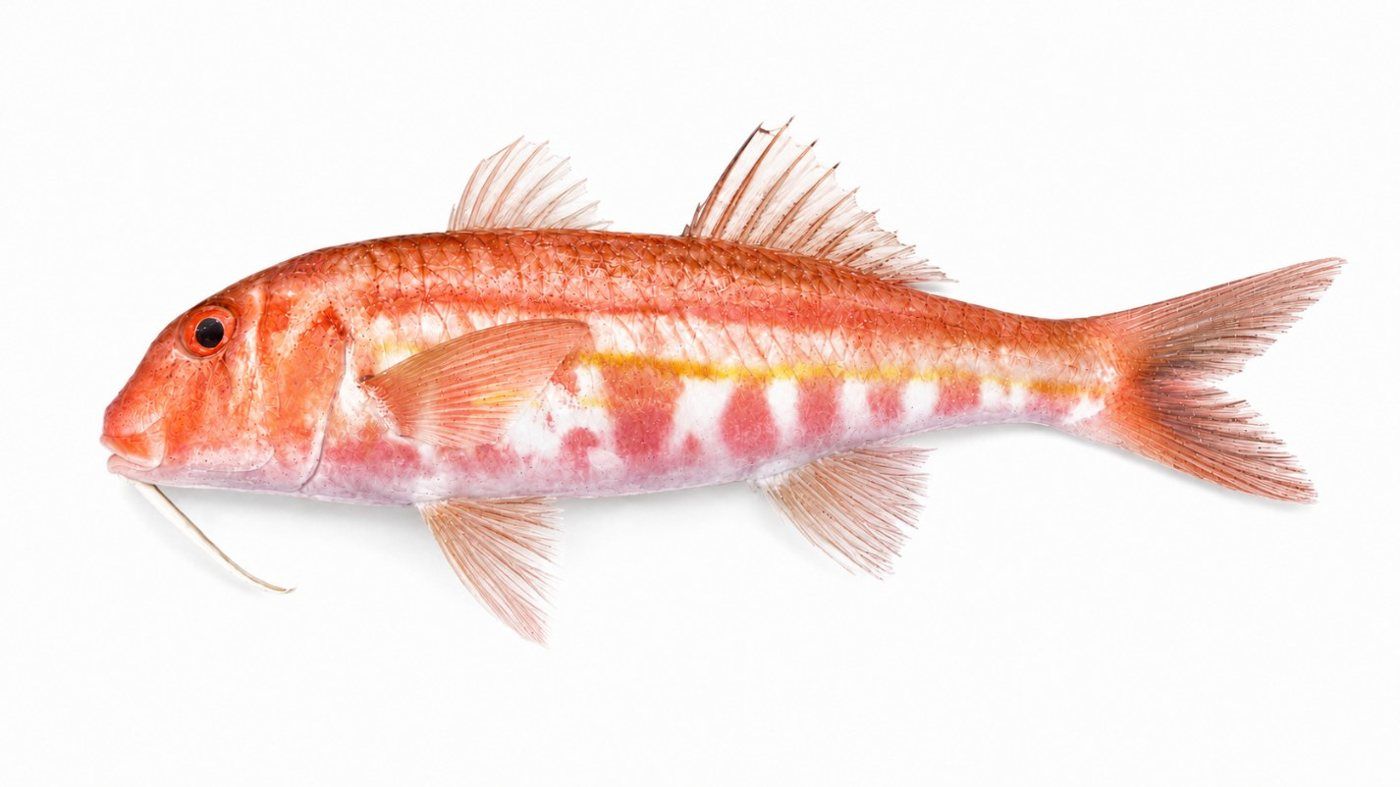
Moderately elongated, compressed body, slightly rounded head profile. Pink to red colouring on the back, lightening towards the pearly white belly, marbled with pinkish bars on the flanks. A yellow longitudinal line runs along the flank. Two long fleshy barbels under the chin, the characteristic sensory organ of goatfishes.
Features that never mislead
- Two long, thick barbels under the chin, folded at rest, extended to search the bottom. The absolute signature of the family Mullidae.
- Clear yellow or golden line along the flank, on a marbled pink background.
- Strong conical teeth in the jaws, some pointing backwards, visible with the mouth closed.
- Two well-separated dorsal fins, body covered with large scales.
Size and weight
Maximum length about 55 cm (SL), common size around 35 cm. Maturity from about 13 cm. On the Ivorian coast, typical catches are between 0.3 and 1.5 kg; it is a modest-sized fish but highly sought after.
Behaviour and ecology
A bottom-rooting fish: it probes the sediment with its two sensory barbels to flush out the benthic invertebrates (worms, crustaceans, molluscs) it feeds on. It frequents the sandy and muddy bottoms of the continental shelf, often in small groups.
Off Côte d’Ivoire, it is a common demersal species of soft bottoms, caught by artisanal and industrial fisheries. Its search for food makes it particularly active at dusk.
Reproduction and season
Coastal spawning. Early maturity (from about 13 cm). The species, with modest growth, is highly exposed to fishing pressure because of its commercial value.
Fishing practice
Techniques, from most to least effective
1. With a handline or light bottom line, using natural bait (worm, shrimp, piece of fish) over sandy and muddy bottoms. The top technique for this bottom rooter.
2. Controlled drifting with the bait held just above the bottom, over the soft grounds of the shelf.
3. With a tenya or light madai over mixed sand and rock bottoms.
A discreet bite, often a series of small taps while the fish noses the bait on the bottom. Strike gently, as the mouth is delicate. The fight is modest but pleasant on light tackle: a few nervy head shakes towards the bottom. A fish of finesse rather than strength.
Eating quality
Fine, delicate white flesh, highly appreciated and considered one of the best of the coastal grounds. Excellent grilled whole, on the plancha or pan-fried. On the West African coast, the goatfish is a noble fish of the market stalls. No need to scale it too early: its thin skin cooks well.
Did you know?
The two barbels under the goatfish’s chin are not mere ornaments: they are sensory organs covered with chemical and touch receptors. The fish extends them to search the sand and mud, literally tasting the bottom to detect buried worms and crustaceans. Its species name, prayensis, refers to Praia, capital of Cape Verde, where it was first described by Cuvier in 1829.
Sources: FishBase (Pseudupeneus prayensis, Cuvier 1829); FAO Field Guide Gulf of Guinea (Schneider, 1990); IUCN Red List (Vulnerable); Ben-Tuvia 1990 (CLOFETA). Ivorian data to be reconfirmed with the CRO Abidjan.