
Bogue
Boops boops (Linnaeus, 1758)
Family Sparidae • the small big-eyed schooling sparid
3 look-alikes to know
| French name | Bogue. Other names: bogue commune, boce. |
|---|---|
| Scientific name | Boops boops (Linnaeus, 1758) |
| Family | Family Sparidae |
| English name (FAO) | Bogue |
| Local names | On Ivorian markets and landing sites: “Bogue” (Ouattara et al., 2016). |
| Habitat | Marine and brackish, demersal and coastal pelagic. Depth 0 to 350 m, most often 0 to 100 m. |
| IUCN status | LC Least Concern. A common species, heavily fished in the Atlantic and the Mediterranean. |
Identification
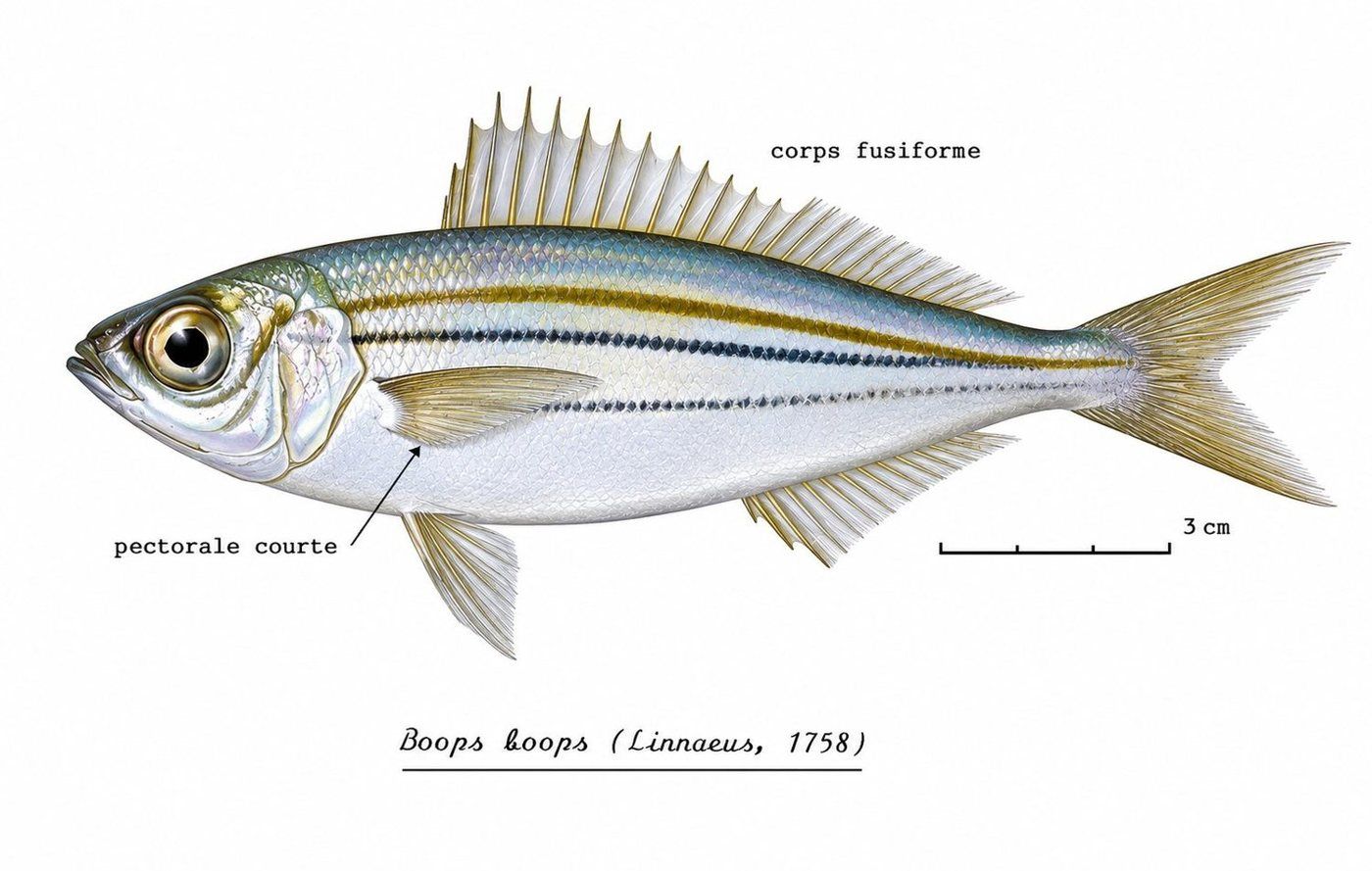
A small sparid with a streamlined, elongated, almost cylindrical body, built for life in a school. Grey-blue to greenish back, silvery flanks crossed by fine golden-yellow longitudinal lines. Very large eye, whose diameter exceeds the length of the snout, hence the Greek name bóōps, ox eye. Small mouth, teeth in a single row, incisor-like. Clearly forked tail fin.
Features that never mislead
Large eye, its diameter exceeds the length of the snout.
Fine golden-yellow longitudinal lines on a silvery background.
Streamlined, almost cylindrical body, slimmer than other sparids.
Teeth in a single row, incisor-like, small mouth.
Size and weight
Common size around 20 cm. Published maximum length about 40 cm total length, for a maximum weight of around 455 g (FishBase). Most catches remain small.
Behaviour and ecology
A gregarious species that forms large schools over the continental shelf, over all types of bottom. Omnivorous: it eats algae, small crustaceans and plankton. Schools often rise towards the surface at night.
Present in the Eastern Atlantic from Norway to Angola, in the Mediterranean and in the Black Sea. On the Ivorian coast, it is a common schooling fish of the shoreline, caught in mixed fisheries. IUCN status: Least Concern.
Reproduction and season
Spawns in coastal open water, pelagic eggs and larvae. Early maturity, at around 13 to 14 cm. The species is hermaphrodite, with some individuals changing sex during their life.
Fishing practice
Techniques, from most to least effective
With a multi-hook rig of small baited hooks (sabiki), deadly on a located school.
With a fine bottom line, using natural bait (worm, piece of shrimp).
As bycatch in coastal nets and seines.
The fight: modest given the small size, quick vibrations on light line. It is mainly a market fish, a frying fish and an excellent live bait for coastal predators.
Eating quality
Decent white flesh, a little soft, eaten fried or braised, often sold in batches at a low price. To be eaten very fresh, as it keeps poorly.
Sources: FishBase (Boops boops, Linnaeus 1758); IUCN Red List, LC; FAO Eastern Central Atlantic; Ouattara et al. 2016.