
Vivaneau guinéen (African red snapper)
Lutjanus agennes Bleeker, 1863
Family Lutjanidae • the orange-red snapper of Africa
3 look-alikes to know
| French name | Vivaneau guinéen. Other names: sosso-noir, vivaneau rouge d'Afrique, African red snapper. |
|---|---|
| Scientific name | Lutjanus agennes Bleeker, 1863 |
| Family | Family Lutjanidae |
| English name (FAO) | Vivaneau guinéen (African red snapper) |
| Local names | On Ivorian markets and landing sites: “Sosso-noir” (Ouattara et al., 2016). |
| Habitat | Marine and brackish, associated with hard bottoms and coastal reefs. Enters estuaries and river mouths. |
| IUCN status | DD Data Deficient. An important species for West African artisanal fishing. |
Identification
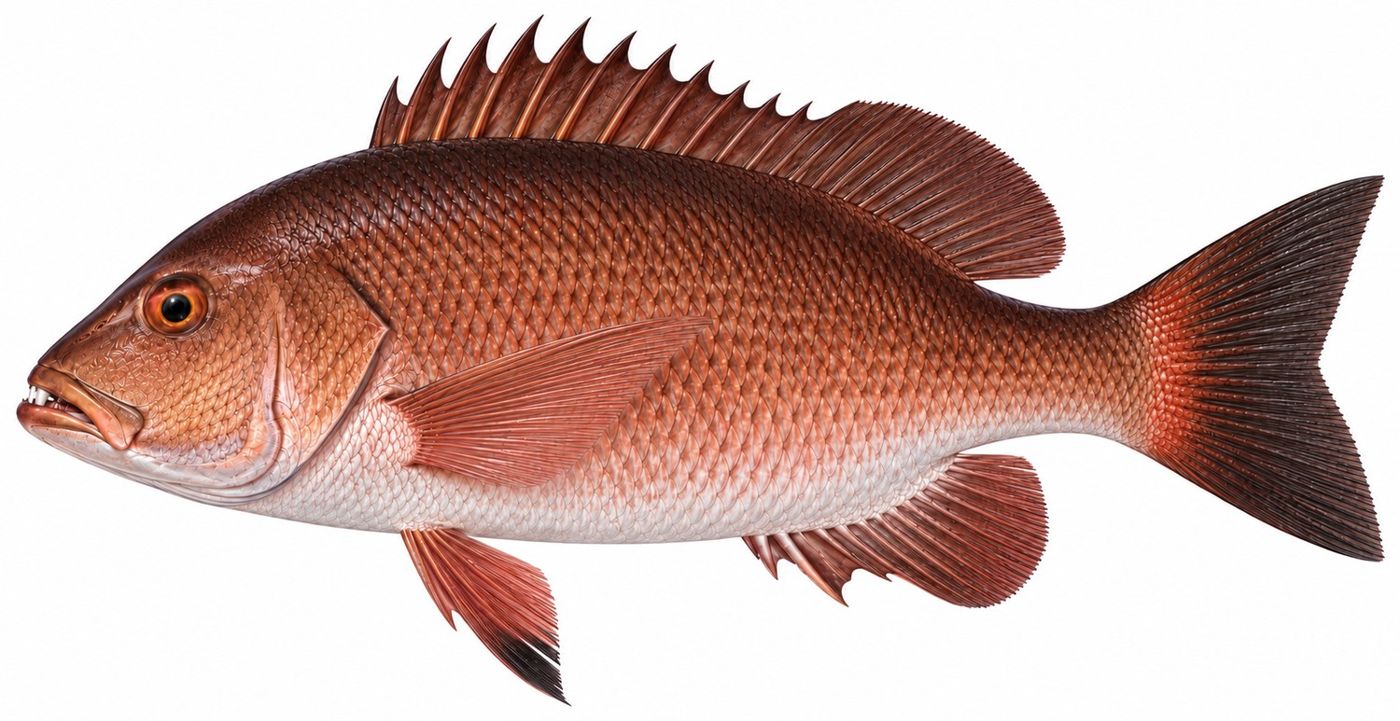
A large snapper with a deep body, pointed snout and rather angular forehead. Wide mouth reaching below the centre of the eye. Red-brown to orange livery on the back and upper flanks, turning pink or whitish towards the belly. Tips of the pelvic fins fairly dark. Vomerine teeth in a triangular patch.
Features that never mislead
Red-brown to orange livery, paler towards the belly.
Deep body, pointed snout, angular forehead.
Wide mouth reaching the centre of the eye.
Dark tips to the pelvic fins.
Size and weight
A large snapper that can well exceed one metre. Precise maximum size to be confirmed on FishBase. On the Ivorian coast, fine fish of several kilos over hard bottoms.
Behaviour and ecology
A demersal predator of hard bottoms, reefs and coastal wrecks. Hunts fish and large crustaceans. Tolerates reduced salinity and frequents the approaches to river mouths.
Present in the Atlantic coastal waters of Africa. On the Ivorian coast, sought after on structures and wrecks. IUCN status: Data Deficient.
Reproduction and season
Coastal spawning, pelagic eggs and larvae. Slow growth. Local spawning data to be documented.
Fishing practice
Techniques, from most to least effective
Bottom fishing with natural bait on wrecks and hard bottoms.
Heavy handline and vertical jig fishing.
With live bait near structures.
The fight: very powerful, with an immediate run towards the structure. You must hold it firmly without easing off, or risk losing everything in the wreck.
Eating quality
Firm, excellent white flesh, highly appreciated. Baked, braised or as a steak. Good value on Ivorian markets.
Sources: FishBase (Lutjanus agennes, Bleeker 1863); IUCN Red List (Data Deficient); FAO Eastern Central Atlantic; Ouattara et al. 2016.