
Aba aba, African knifefish
Gymnarchus niloticus Cuvier, 1829
Family Gymnarchidae • the gentle electric “eel” that swims backwards
| French name | Gymnarque, Nile knifefish, aba |
|---|---|
| Scientific name | Gymnarchus niloticus Cuvier, 1829 |
| Family | Family Gymnarchidae |
| English name (FAO) | Aba aba, African knifefish |
| Local names | Aba, knifefish; local names to be documented |
| Habitat | Freshwater: swamps, floodplains, weed beds of rivers and floodplain lagoons. Demersal to semi-pelagic. |
| IUCN status | LC Least Concern. |
Identification
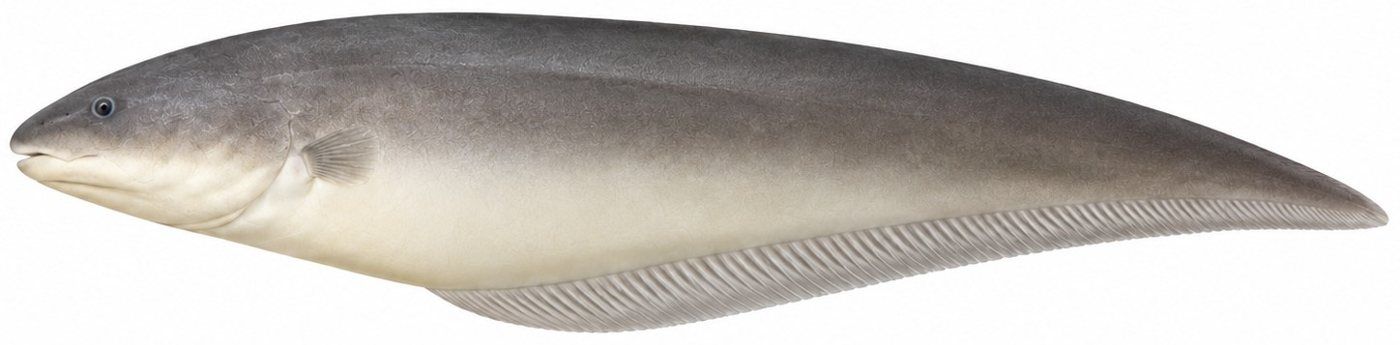
Very elongated, eel-like body, brown to grey, tapering to a point (no caudal, anal or pelvic fins). A very long undulating dorsal fin runs along almost the whole back and provides propulsion, including in reverse. Weakly electric, like the mormyrids.
Features that never mislead
Eel-like outline ending in a fine point, with no true tail.
Single long undulating dorsal fin along the whole back, the main engine.
No anal, pelvic or caudal fins.
Swims forwards as well as backwards; weak electric field.
Size and weight
Usually 60 to 90 cm; published maximum around 1.6 m for more than 18 kg.
Behaviour and ecology
A predator of weed beds, it ambushes fish and invertebrates, guided by its electric sense through dense vegetation and murky water. Occasionally breathes air. Territorial and hardy.
Reproduction and season
Oviparous and remarkable: it builds a large floating nest of plants in flooded weed beds, where the male fiercely guards the eggs and the fry, which have external gills.
Fishing practice
Techniques, from most to least effective
Bottom line or live bait in gaps in weed beds. The top technique.
Cast net and net in subsistence fishing.
Trap in vegetated channels.
A powerful, snake-like catch that twists itself in the line and heads for the weed. Mouth lined with sharp teeth: strike firmly and unhook with pliers. Slippery body, hold it firmly.
Eating quality
Popular, firm white flesh; eaten grilled or smoked. A sought-after fish in inland markets.
Sources: FishBase (Gymnarchus niloticus, Cuvier 1829); IUCN Red List (Least Concern); Lévêque & Paugy. Local names to be documented.