
Electric catfish
Malapterurus electricus (Gmelin, 1789)
Family Malapteruridae • the catfish that stuns its prey, the local “electric eel”
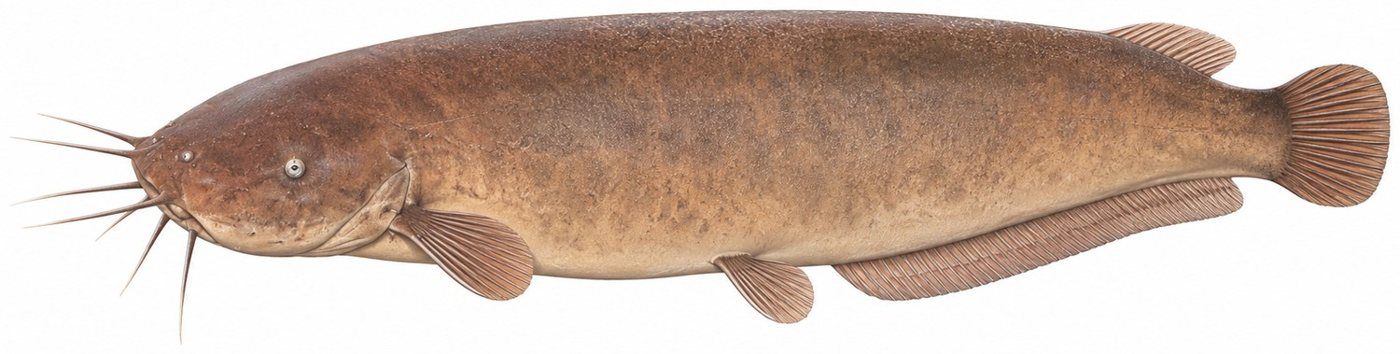
| French name | Silure électrique, electric catfish. Often called “electric eel” locally |
|---|---|
| Scientific name | Malapterurus electricus (Gmelin, 1789) |
| Family | Family Malapteruridae |
| English name (FAO) | Electric catfish |
| Local names | “Fish that gives a shock”, “electric eel”; local names to be documented |
| Habitat | Freshwater: rivers, floodplain lagoons, slow areas with hiding places (stumps, undercut banks). Demersal, nocturnal. |
| IUCN status | LC Least Concern. |
Identification
A catfish with a thick, cylindrical body, pinkish-grey to brownish marked with dark spots, without a rayed dorsal fin (only an adipose fin further back). Three pairs of barbels around a wide mouth. It produces strong electric discharges (more than 300 volts) thanks to an electric organ wrapped around the whole body.
Features that never mislead
Fleshy, naked, spotted body without a spiny dorsal: the outline of a fat sausage.
A single small adipose fin near the tail, no rayed dorsal.
Three pairs of barbels; small eyes; smooth skin.
Capable of a powerful electric discharge (defence and prey capture).
Size and weight
Usually 40 to 60 cm; published maximum over 1 m for more than 20 kg in very large specimens.
Behaviour and ecology
A solitary, territorial nocturnal predator that lies hidden by day under banks and stumps. It stuns its prey (fish) with an electric burst before swallowing them. Active mainly at night; tolerates warm, poorly oxygenated water.
Reproduction and season
Oviparous; breeds in the rainy season, spawns in burrows or cavities in the banks. Breeding biology still poorly documented in the wild.
Fishing practice
Techniques, from most to least effective
Bottom line with fish bait (live or dead) along undercut banks, at night. The top technique.
Bottom longline set near hiding places.
Trap and net in subsistence fishing.
WARNING: the electric catfish delivers a real and painful shock when caught. Never grab it bare-handed; use a landing net, thick gloves and unhooking pliers, and lay it on an insulating surface. A heavy, brief fight, but the risk is electrical, not mechanical.
Eating quality
White, oily flesh, eaten locally (grilled, smoked, in sauce). The discharge stops when the animal dies; the fish is safe once handled with care.
Sources: FishBase (Malapterurus electricus, Gmelin 1789); IUCN Red List (Least Concern); Lévêque & Paugy. Distinction from Electrophorus (South America). Local names to be documented.