
Nile tilapia
Oreochromis niloticus (Linnaeus, 1758)
Family Cichlidae • the “carpe” of our waters, queen of aquaculture
1 look-alike to know
| French name | Nile tilapia. Commonly called “carpe” in Côte d'Ivoire |
|---|---|
| Scientific name | Oreochromis niloticus (Linnaeus, 1758) |
| Family | Family Cichlidae |
| English name (FAO) | Nile tilapia |
| Local names | Carpe, tilapia; local names to be documented |
| Habitat | Freshwater: rivers, reservoirs, ponds, canals; tolerates brackish water. Demersal to coastal pelagic. |
| IUCN status | LC Least Concern. A very widely farmed and introduced species. |
Identification
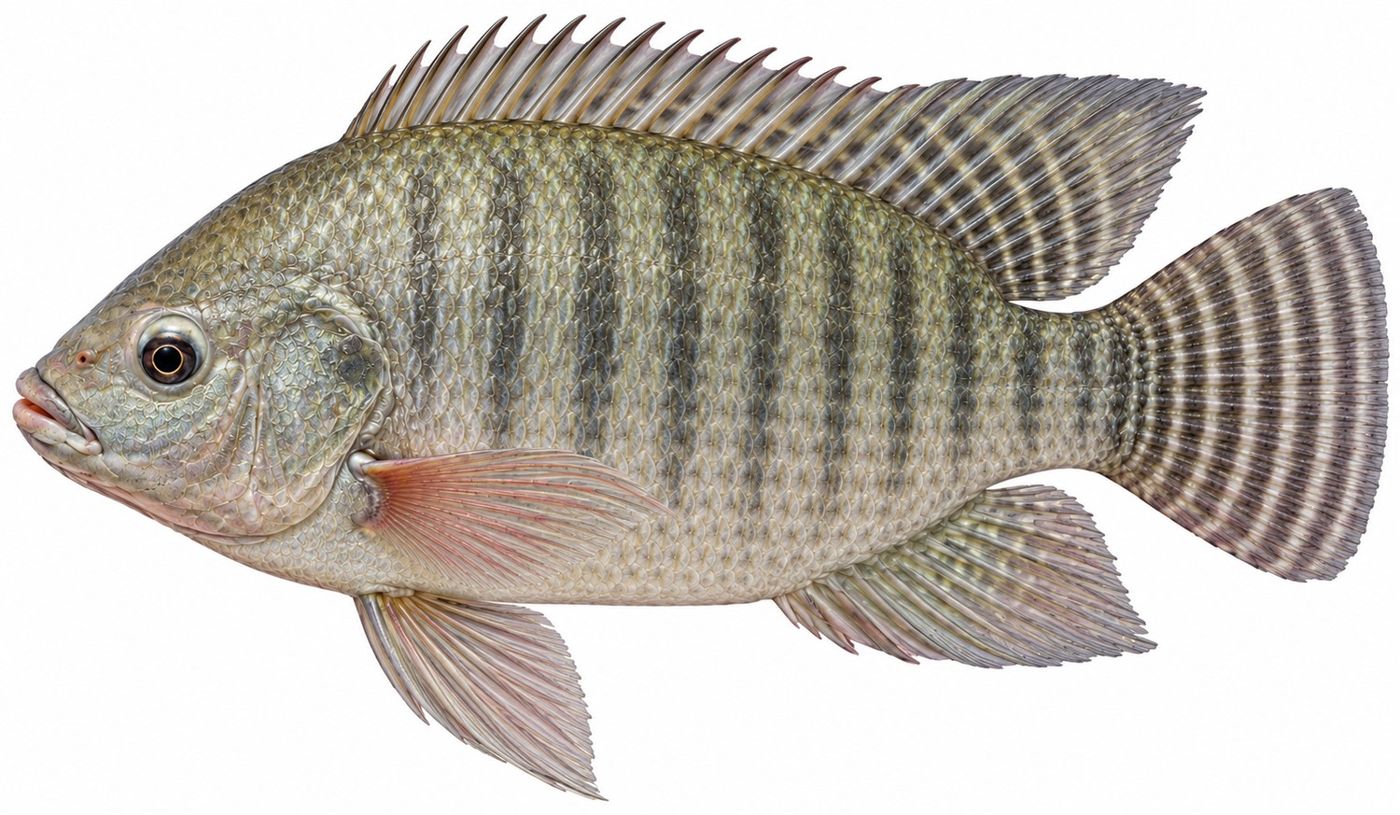
A cichlid with a deep, compressed body, grey-green to silvery, marked with more or less distinct dark vertical bars; the caudal often bears characteristic fine vertical bands. A single long dorsal fin with a spiny part. In the breeding season, males take on colour (reddish throat and fin edges).
Features that never mislead
Deep, compressed body with dark vertical bars on the flanks.
Regular vertical bands on the caudal fin (a useful feature).
Single long dorsal fin, spiny at the front.
Breeding male more colourful; builds bowl-shaped nests.
Size and weight
Usually 20 to 35 cm; published maximum around 60 cm for about 4 kg.
Behaviour and ecology
An omnivore leaning towards herbivory: algae, phytoplankton, detritus, small invertebrates. Very tolerant (temperature, oxygen, salinity), gregarious, prolific. These qualities make it one of the most farmed fishes in the world and a mainstay of Ivorian stocked reservoirs.
Reproduction and season
A mouthbrooder: the female takes the fertilised eggs into her mouth and shelters the fry there, which swim back in at the slightest danger. Almost continuous breeding in warm water, hence a strong ability to populate a water body.
Fishing practice
Techniques, from most to least effective
Float fishing with groundbait and a small bait (paste, worm, bread) in calm areas. The top technique, ideal for beginners.
Light bottom line near banks and weed beds.
Cast net and net in subsistence fishing.
A spirited catch for its size: the tilapia turns sideways and pulls in bursts. Small mouth: fine hook and small bait. Easy to handle, but avoid the prickly dorsal spines.
The float rig, piece by piece
- Telescopic pole of 3 to 5 m, no reel
- Main line: nylon 0.16 to 0.20 mm
- Small float of 1 to 3 g
- Shotting of small grouped split shots
- Fine hook link, nylon 0.14 mm
- Fine hook size 10 to 14
- Small ball of bait (paste, bread, worm) on the hook
- Groundbait drifting down near the hook bait
Eating quality
Mild white flesh, very popular, the everyday eating fish par excellence; the star of Abidjan grilled fish (the famous “poisson braisé, attiéké”). Suits grilling, frying and sauces.
Sources: FishBase (Oreochromis niloticus, Linnaeus 1758); IUCN Red List (Least Concern); FAO aquaculture; Lévêque & Paugy. Local names to be documented. Illustrated rig (2026): indicative values from common sport-fishing practice (IGFA line classes, West African fishing-guide usage), to be confirmed with local anglers.