
African sharptooth catfish
Clarias gariepinus (Burchell, 1822)
Family Clariidae • the catfish that walks and breathes air, king of fish farming
| French name | Silure africain, African catfish. Closely related species: Clarias anguillaris |
|---|---|
| Scientific name | Clarias gariepinus (Burchell, 1822) |
| Family | Family Clariidae |
| English name (FAO) | African sharptooth catfish |
| Local names | Silure; “yégé” (Dioula, usage); local names to be documented |
| Habitat | Freshwater: ponds, swamps, rivers, reservoirs, canals; very tolerant. Demersal. |
| IUCN status | LC Least Concern. A flagship aquaculture species. |
Identification
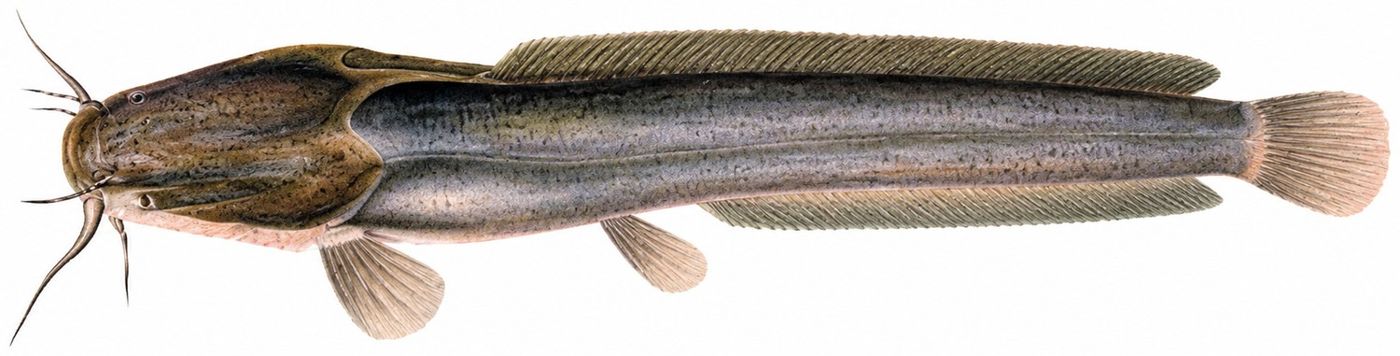
A large catfish with an elongated, naked (scaleless) body, grey to mottled brown, broad flattened head, four pairs of barbels. Very long, low dorsal and anal fins running to the tail. Strong spiny ray in the pectorals. A tree-like breathing organ lets it breathe air.
Features that never mislead
Naked, eel-like body with long, low dorsal and anal fins.
Broad, flat head; four pairs of barbels.
Sturdy, sharp pectoral spine (handle with care).
Breathes air: survives out of water and moves over damp ground.
Size and weight
Usually 40 to 80 cm; published maximum close to 1.7 m for more than 50 kg in giants.
Behaviour and ecology
A voracious, nocturnal omnivore: insects, molluscs, fish, seeds, detritus. Extraordinarily resilient, it tolerates mud, heat and lack of oxygen, and can crawl from one pond to another in wet weather. These assets make it the leading species of Ivorian and West African fish farming.
Reproduction and season
Very prolific and oviparous; spawns at night in the rainy season in flooded, weedy areas, with no parental care. Breeding is controlled in hatcheries (hormone induction) for aquaculture.
Fishing practice
Techniques, from most to least effective
Bottom line with natural bait (worm, tripe, piece of fish, paste) at night. The top technique.
Bottom longline in ponds and canals.
Trap and cast net in subsistence fishing.
A heavy, stubborn fight, pulling towards the bottom and hiding places. Grip it behind the head with a cloth, never with a full hand: the pectoral spine stabs deeply and the body is very slippery.
The bottom rig, piece by piece
- Powerful rod 2.70 to 3 m on a rest
- Spinning reel size 5000 to 6000
- Main line: nylon 0.40 to 0.50 mm or braid 30 to 50 lb
- Sliding lead of 40 to 100 g
- Bead and swivel
- Nylon hook link 0.45 to 0.60 mm, 50 cm
- Strong single hook 2/0 to 6/0
- Bait: chunk of fish, offal or big worm
- Bell on the rod tip to hear the bite
Eating quality
White to pinkish, oily and tasty flesh, very popular, especially smoked (smoked catfish, a key ingredient of many sauces) or in light soup. A mainstay of markets and popular eateries.
Sources: FishBase (Clarias gariepinus, Burchell 1822); IUCN Red List (Least Concern); FAO aquaculture; Lévêque & Paugy. Local names to be documented. Illustrated rig (2026): indicative values from common sport-fishing practice (IGFA line classes, West African fishing-guide usage), to be confirmed with local anglers.