
Bayad
Bagrus bajad (Forsskål, 1775)
Family Bagridae • the slender catfish of the big rivers
| French name | Bagre. Related species: Bagrus docmak |
|---|---|
| Scientific name | Bagrus bajad (Forsskål, 1775) |
| Family | Family Bagridae |
| English name (FAO) | Bayad |
| Local names | Bagre, silure; local names to be documented |
| Habitat | Freshwater: large rivers, lakes and reservoirs, open bottoms; demersal. |
| IUCN status | LC Least Concern. |
Identification
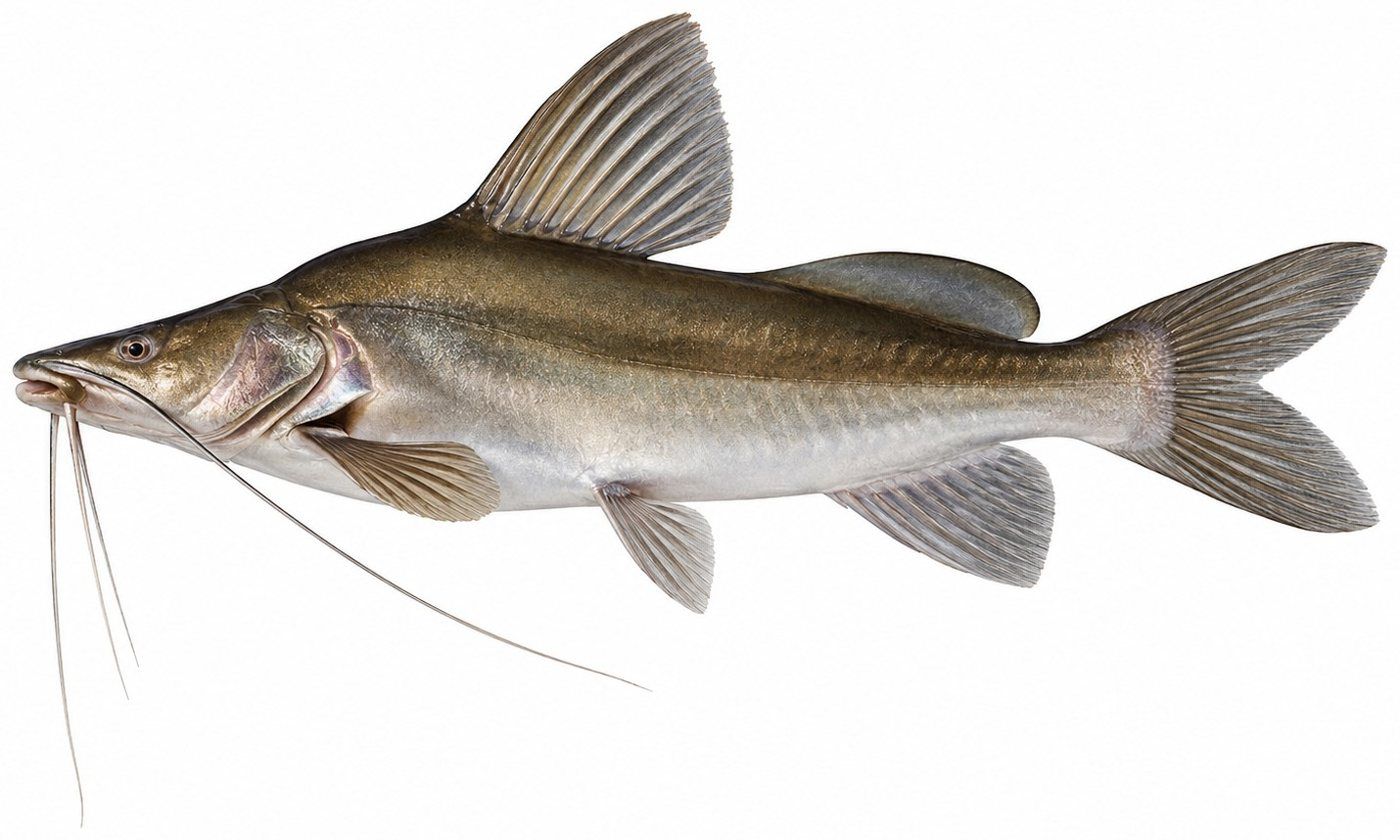
A catfish with an elongated, naked body, grey to light brown, often with dark spots, depressed head. Four pairs of long barbels. Short rayed dorsal followed by a long adipose fin; clearly forked caudal with pointed lobes. Well-developed dorsal and pectoral spines.
Features that never mislead
Long adipose fin and deeply forked caudal (slender outline).
Four pairs of well-developed barbels.
Naked, pale, spotted body; flattened head.
Sturdy dorsal and pectoral spines.
Size and weight
Usually 40 to 80 cm; published maximum over 1 m for several tens of kilos.
Behaviour and ecology
A nocturnal bottom predator: fish, crustaceans, insects. Seeks the open, deep water of large rivers and reservoirs, where it hunts by ambush. An important fish in Sahelian-Sudanian inland fisheries.
Reproduction and season
Oviparous; spawns in the high-water season. Some bagrids guard the nest; biology varies by habitat.
Fishing practice
Techniques, from most to least effective
Bottom line or live bait in the holes of large rivers, at night. The top technique.
Bottom longline set away from the banks.
Bottom gillnet in subsistence fishing.
A powerful fight hugging the bottom; large specimens are fine opponents. Handle behind the head; prickly pectoral and dorsal spines; slippery body.
Eating quality
Fine, prized white flesh, less oily than Clarias; excellent grilled or in sauce, appreciated fresh as well as smoked.
Sources: FishBase (Bagrus bajad, Forsskål 1775); IUCN Red List (Least Concern); FAO inland fisheries; Lévêque & Paugy. Local names to be documented.