
Wahoo
Acanthocybium solandri (Cuvier, 1832)
Family Scombridae • the barred arrow of the open sea
2 look-alikes to know
| French name | Thazard noir. Other names: wahoo, thazard-bâtard, thazard raité, thon banane. |
|---|---|
| Scientific name | Acanthocybium solandri (Cuvier, 1832) |
| Family | Family Scombridae |
| English name (FAO) | Wahoo |
| Local names | On Ivorian markets and landing sites: “Assaf long” (Ouattara et al., 2016). |
| Habitat | Marine, oceanic pelagic, highly migratory. Surface to 20 m, most often 0 to 12 m. |
| IUCN status | LC Least Concern. Tropical and subtropical Atlantic, Indian and Pacific Oceans. |
Identification
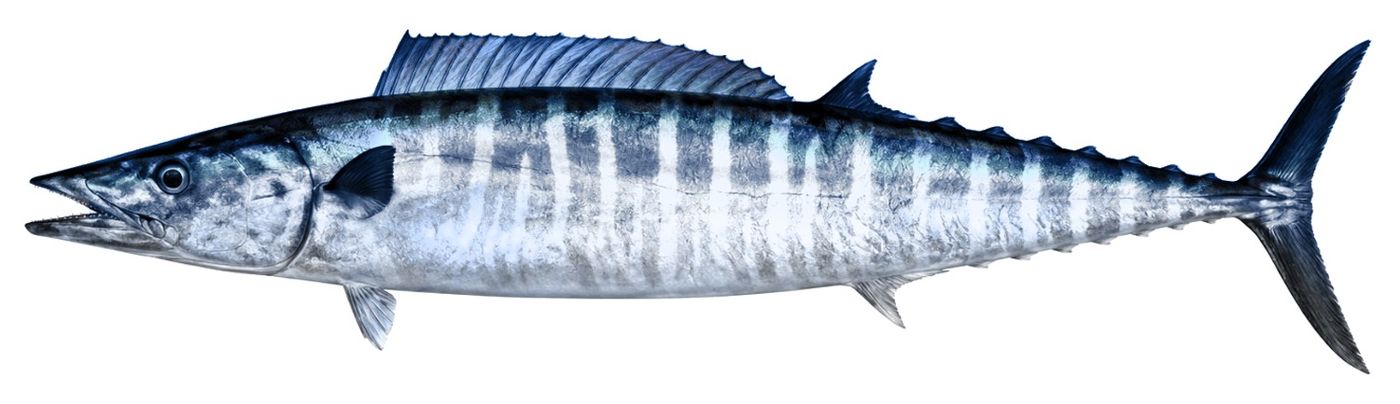
Very elongated, streamlined and compressed body, the most slender of the Scombridae. Iridescent steel-blue back, silvery flanks crossed by blue-black vertical bands. Long, pointed beak-like snout, jaws armed with sharp triangular teeth. Two dorsal fins followed by detached finlets.
Features that never mislead
- Some twenty blue-black vertical bars running down the silvery flanks.
- Long, narrow beak-like snout, jaws lined with saw-like triangular teeth.
- Detached finlets behind the second dorsal and anal fins, keels on the caudal peduncle.
- Very slender body, crescent-shaped tail: an arrow-like silhouette.
Size and weight
Common length around 170 cm (FL). Published maximum length 250 cm TL; weight can exceed 80 kg. Maturity at about 100 cm. Off the Ivorian coast, catches are often between 8 and 25 kg, with very large fish offshore.
Behaviour and ecology
A solitary predator or one living in small loose groups, among the fastest fish in the ocean. It swoops on sardinellas, mackerel, squid and small tunas in lightning attacks, slicing its prey with its teeth.
Off Côte d’Ivoire it frequents the shelf edge, the surroundings of seamounts and floating objects, often in clear blue water.
Reproduction and season
Spawns in tropical open water over a broad seasonal window. Fast growth. Local spawning data to be confirmed (FAO/CRO).
Fishing practice
Techniques, from most to least effective
- By fast trolling (8 to 12 knots) with tough lures and a wire trace, along the drop-off and around structures. The top technique.
- By speed jigging when the fish is spotted at depth.
- With drifted live or cut bait, wire trace essential.
One of the most violent first runs in the sea: the line smokes off the reel. Firm but not locked drag; let the first run go, then gain line by pumping. Take the utmost care with the teeth when bringing it aboard: gaff or net it carefully, never grab it near the mouth.
Eating quality
White to pinkish flesh, firm, fine and lean, highly prized as sashimi, grilled or as steaks. Bleed immediately. It is one of the most sought-after trolling fish for the table.
Did you know?
The wahoo is built for explosive speed: its arrow-shaped body, smooth skin and rigid tail make it one of the fastest fish of the open sea, with bursts estimated at over 70 km/h. Its Latin name, solandri, honours Daniel Solander, a Swedish naturalist and pupil of Linnaeus who accompanied Cook in the Pacific.
Sources: FishBase (Acanthocybium solandri, Cuvier 1832); IUCN Red List (Least Concern); FAO Scombrids of the World (Collette & Nauen 1983); French Wikipedia. Ivorian data to be reconfirmed with the CRO Abidjan.