
Atlantic sailfish
Istiophorus albicans (Latreille, 1804)
Family Istiophoridae • the sprinter with the great dorsal sail
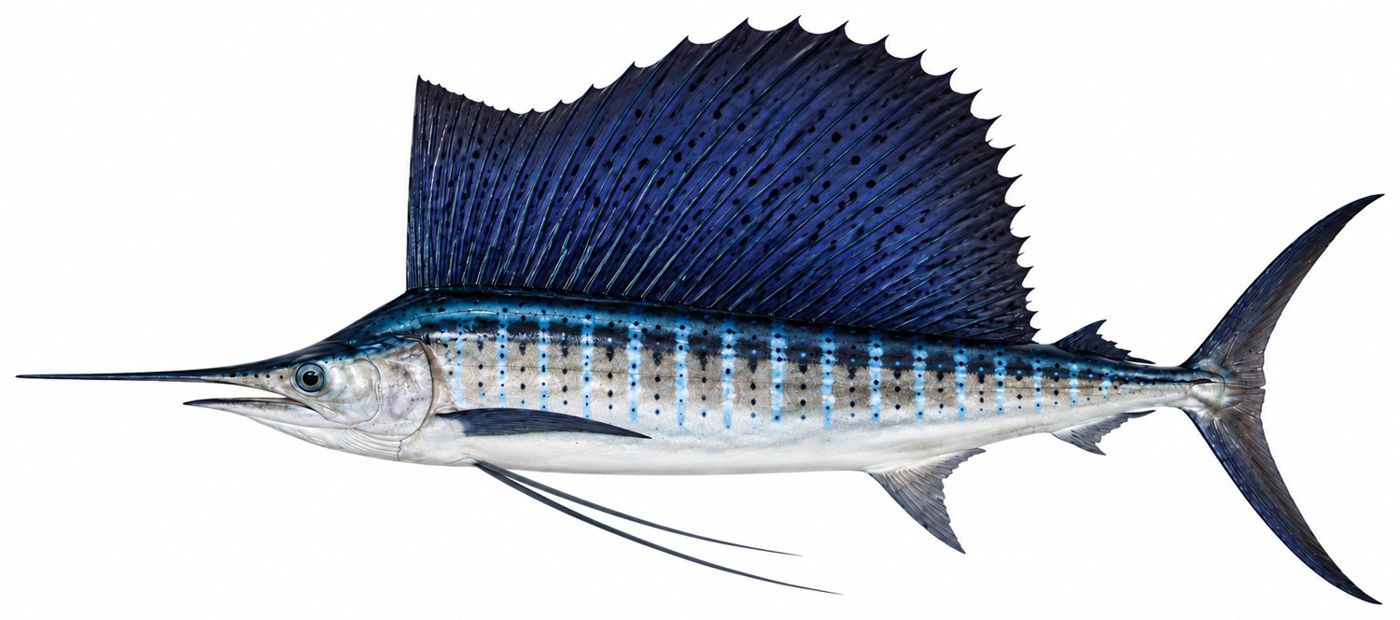
| French name | Voilier de l’Atlantique. |
|---|---|
| Scientific name | Istiophorus albicans (Latreille, 1804) |
| Family | Family Istiophoridae |
| English name (FAO) | Atlantic sailfish |
| Local names | On Ivorian markets and landing sites: “Voilier” (Ouattara et al., 2016). |
| Habitat | An oceanic surface pelagic predator, highly migratory, that hunts schools of baitfish in small groups (sardinellas, mackerel, squid), driving them |
| IUCN status | NE Not Evaluated / to be checked. |
Identification
Slender, compressed silhouette extended by a thin, round bill. The unmistakable signature: a huge sail-shaped first dorsal fin, much taller than the body, which it raises to manoeuvre and to intimidate. Dark blue back, silvery flanks often crossed by lines of bluish dots. Very long, thread-like pelvic fins, present unlike in the swordfish. The smallest and fastest of the large istiophorids.
Features that never mislead
Giant sail-like first dorsal fin, taller than the depth of the body.
Thin, round bill, more slender than that of the marlin.
Long, thread-like pelvic fins, present, which separate it from the Xiphiidae.
Vertical bars of bluish dots on the silvery flanks.
Size and weight
Common size around 1.8 to 2.5 m. Maximum length about 3.15 m, with a typical weight of 20 to 60 kg. Females are larger than males.
Behaviour and ecology
An oceanic surface pelagic predator, highly migratory, that hunts schools of baitfish in small groups (sardinellas, mackerel, squid), driving them together by raising its sail before striking with its bill. One of the fastest fish known, capable of spectacular bursts.
Present in the tropical and warm temperate waters of the Atlantic, between 21 and 28 degrees. Off Côte d’Ivoire it is an emblematic trophy of offshore sport fishing. Taxonomic note: Istiophorus albicans is sometimes considered a synonym of the Indo-Pacific sailfish Istiophorus platypterus, but several authors retain the Atlantic species. Caught mainly in sport fishing and as longline bycatch.
Reproduction and season
Spawns in warm open water during the warm season; pelagic eggs and larvae. Fast growth in the first years.
Fishing practice
Techniques, from most to least effective
Offshore trolling, the main sport method. Medium-sized skirted lures and rigged natural baits, ballyhoo or small baitfish, are trolled behind the boat in a spread on the outriggers and in the wake.
Teasers and pitch-baits. Hookless lures, the teasers, raise the sailfish behind the boat; as soon as it chases them, the teaser is pulled away and a natural bait on a light rig is presented. It is the most sporting method and the one that harms the fish the least.
Live bait, presented on feeding frenzies spotted by birds or on the sounder, above schools of sardinella or horse mackerel.
The pitch-bait rig, piece by piece
- Straight (never offset) 5/0 circle hook, so that it hooks in the corner of the jaw.
- Fine copper or monel wire to rig the ballyhoo on the hook, the hook set in front of the head.
- About 4.5 m of 30 lb fluorocarbon leader (14 kg), joined to the main line with an Albright or blood knot.
The right moves
With a circle hook, do not strike: let the sailfish take the bait and swim away, then apply drag gradually and the hook sets itself in the corner of the mouth. A hard strike pulls the bait away or hooks the fish deep in the throat.
The fight: explosive and aerial, with repeated jumps and surface runs with the sail raised, one of the finest spectacles in big-game fishing. Release after the fight is the sporting norm.
Eating quality
Decent but dry flesh, less fine than tuna or swordfish. Eaten smoked or as steaks, mainly locally. The species’ high sporting value justifies release rather than consumption.
Sources: FishBase (Istiophorus albicans, Latreille 1804; synonymy I. platypterus); FAO Billfishes of the World, Nakamura 1985; ICCAT; Ouattara et al. 2016. Fishing techniques and rigs (2026): ICCAT Recommendations 15-03 (South Atlantic swordfish), 16-11 (sailfish) and 19-05 (marlins); On The Water, “Daytime Swordfish”; West Marine, “How to Catch Swordfish”; AFTCO, “Best Marlin Lure Spread”, Captain Peter B. Wright; George Poveromo, “Types of Trolled Ballyhoo Rigs” (accessed 26/10/2026).