
Atlantic blue marlin
Makaira nigricans Lacepède, 1802
Family Istiophoridae • the cobalt giant of offshore battles
| French name | Marlin bleu de l’Atlantique. |
|---|---|
| Scientific name | Makaira nigricans Lacepède, 1802 |
| Family | Family Istiophoridae |
| English name (FAO) | Atlantic blue marlin |
| Local names | On Ivorian markets and landing sites: “Sogodjegue” (Ouattara et al., 2016). |
| Habitat | A large oceanic pelagic predator of warm waters, mostly solitary, that travels vast distances following thermal fronts and concentrations |
| IUCN status | VU Vulnerable. See main text of the sheet. |
Identification
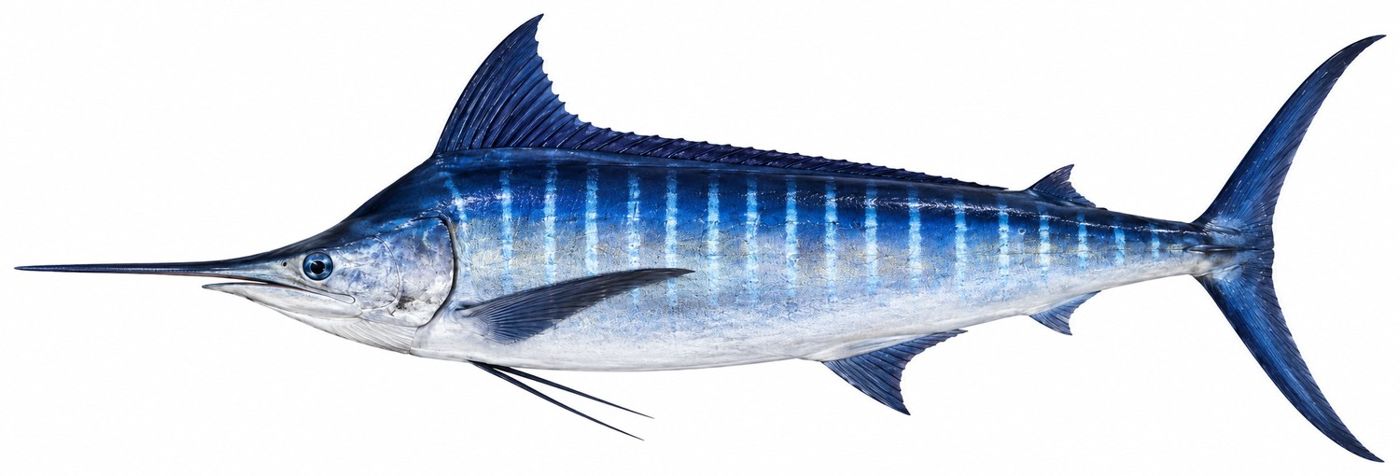
The largest of the Atlantic marlins. Elongated, robust, only slightly compressed body; intense cobalt-blue back turning silvery white on the belly. Stout, round bill, shorter than the swordfish’s. First dorsal fin pointed at the front but never sail-like, lower than the depth of the body. Caudal peduncle with marked double keels on each side. Flexible pectoral fins that fold flat against the body.
Features that never mislead
Intense cobalt-blue back, silvery white belly.
First dorsal fin pointed at the front but lower than the body, never sail-like.
Stout, round bill, double keel on the caudal peduncle.
Females much larger than males, which rarely exceed 160 kg.
Size and weight
Common size around 2.9 m. Maximum length about 5 m, with a weight exceeding 800 kg in the largest females (FishBase). Males rarely exceed 160 kg; all very large fish are females.
Behaviour and ecology
A large oceanic pelagic predator of warm waters, mostly solitary, that travels vast distances following thermal fronts and concentrations of prey. It feeds on tunas, squid and pelagic fish, which it hunts at the surface and at depth.
Present in all tropical and subtropical waters of the Atlantic. Off Côte d’Ivoire it is the ultimate big-game trophy out of Abidjan and Assinie. IUCN status Vulnerable: the species is overfished in the Atlantic and Indian Oceans, with a decline of around a third over three generations. Managed by ICCAT; release strongly encouraged.
Reproduction and season
Spawns in tropical open water; pelagic eggs and larvae. Late maturity and long generations make the species sensitive to overfishing.
Fishing practice
Techniques, from most to least effective
Offshore trolling with large skirted lures, the king of big-game methods. Four or five lures are run in a spread: a large flat-faced lure (chugger) close in the wake, others further back on the outriggers, and a small lure in the centre, far behind (the “shotgun”).
Live bonito or small tuna, slow-trolled at the surface over baitfish areas.
Teaser followed by a pitch-bait, as for the sailfish, with a heavier rig.
The trolling spread, line by line
- In the wake, close to the boat: large flat-faced lure, single 12/0 hook set far back in the skirt; 2.4 m of 480 lb cable then 6 m of 400 lb monofilament leader (180 kg).
- Short outrigger, at 30 to 45 m: flat-faced or wide-range lure, single 11/0 hook on 400 lb.
- Long outrigger, up to 90 m: all-round lure on at least 300 lb (135 kg), two 8/0 or 9/0 hooks, one in the head, the other far back, barely covered by the skirt.
- Centre line, at least 45 m back: small metal-headed lure of 8 to 13 cm, pink or chocolate, 8/0 or 9/0 hook on 300 lb.
- Skirt colour to match the baitfish of the moment: chocolate or pink with squid, blue or blue and white with flying fish, green and yellow with mackerel and horse mackerel.
The right moves
The strike drag, about 11 kg, is set in advance and only reduced once at least 180 m of line are out. During the fight, the skipper helps the angler by manoeuvring the boat to regain line.
The fight: the pinnacle of big-game fishing, with powerful, repeated jumps, very long runs and fights that can last hours. Heavy tackle and experience are essential. Release is the responsible practice.
Eating quality
Dense flesh of average quality, eaten smoked or as steaks where it is landed. Given its Vulnerable status and its sporting value, release after the fight is strongly recommended over consumption.
Sources: FishBase (Makaira nigricans, Lacepède 1802); IUCN Red List, Vulnerable, T46936155; FAO Billfishes of the World, Nakamura 1985; ICCAT; Ouattara et al. 2016. Fishing techniques and rigs (2026): ICCAT Recommendations 15-03 (South Atlantic swordfish), 16-11 (sailfish) and 19-05 (marlins); On The Water, “Daytime Swordfish”; West Marine, “How to Catch Swordfish”; AFTCO, “Best Marlin Lure Spread”, Captain Peter B. Wright; George Poveromo, “Types of Trolled Ballyhoo Rigs” (accessed 26/10/2026).